Tharsis Ship Management has secured support from the EU Innovation Fund for its eSeaRiverBarge project, advancing plans for zero-emission sea-river operations between the Rhine Valley and the United Kingdom.
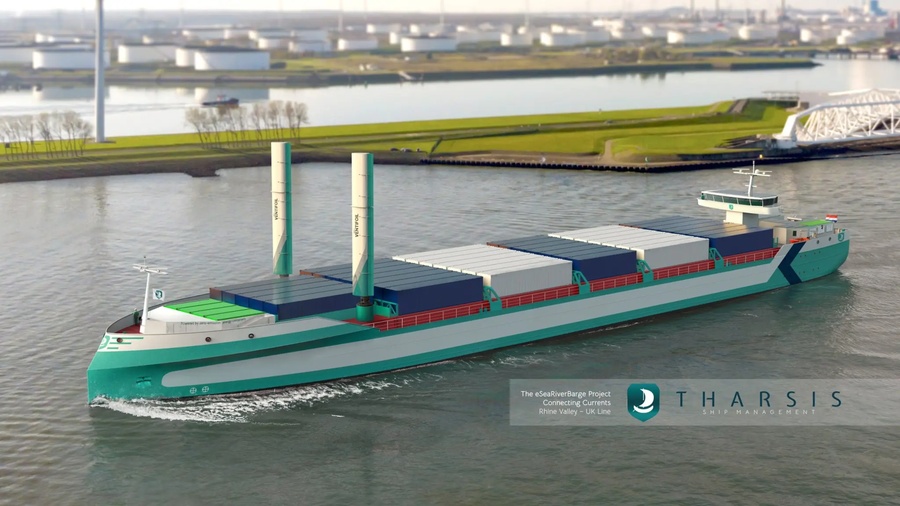
The funding will support the development and construction of two sea-river container vessels. The ships are designed to operate without emissions on inland legs while retaining seagoing capability. Construction is scheduled to start in early 2027, with the first vessel expected to enter service in 2029.
The design is centered on 16 positions for swappable ISO energy containers. These containers can store batteries, hydrogen or ammonia, allowing the vessels to adapt to different energy sources as technology develops.
During the initial phase, the vessels will use ZESpacks supplied by Zero Emission Services under an Energy and Charging as a Service model. The system allows batteries to be exchanged at charging stations, reducing downtime compared with fixed charging arrangements.
The eSeaRiverBarge concept combines wind-assisted propulsion using non-rotating suction wings, hull air lubrication and a triple electric propulsion system. These technologies are integrated into a hull designed for both sea and river operations.
That dual capability is important for sea-river shipping, where vessels must operate on shallow inland waterways during low water periods while also maintaining performance in open sea conditions.
The vessels will also include two biofuel generators as backup power, supporting operational resilience during the transition toward fully zero-emission operations.
The project targets a specialized but strategically important segment of European shipping. By enabling direct transport between inland terminals and seaports, sea-river vessels can reduce handling steps and avoid road transport.
Tharsis Ship Management aims to demonstrate a fully operational zero-emission liner service in the sea-river segment. The project also highlights the potential for containerized energy systems to support future short sea shipping corridors as battery technology and alternative fuels continue to develop.