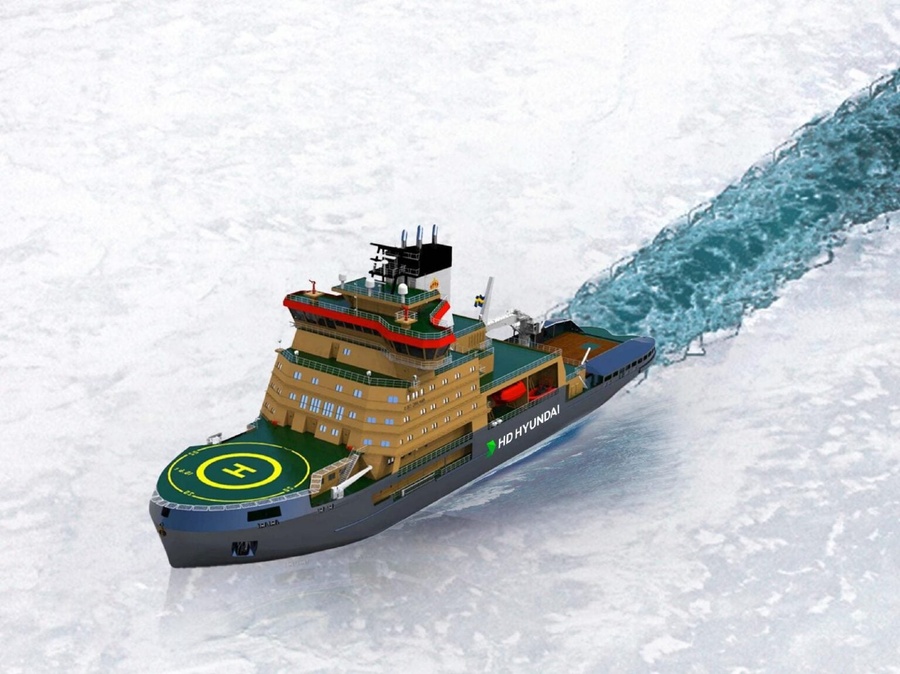
HD Hyundai Heavy Industries has secured an order from the Swedish Maritime Administration to build a dedicated non-commercial icebreaker, marking its first overseas contract in this vessel segment.
The contract is valued at $348.9 million and covers the delivery of one Polar Class 4 icebreaker by 2029. The vessel will be 126 m long with a displacement of about 15,000 tonnes. It will be used for icebreaking operations, convoy escort, and ice management in the Baltic Sea. The ship will also be capable of breaking through ice up to 1.2 m thick.
The order is a notable development for South Korea’s shipbuilding sector, which has built a strong position in commercial vessels such as container ships and LNG carriers, while having a limited presence in dedicated non-commercial icebreakers.
The Swedish order could serve as a turning point for Korean shipbuilders in the icebreaker market, where Finland and Russia have long held leading positions.
The contract comes as South Korea steps up efforts related to Arctic shipping routes. Industry analysts said these routes are expected to draw greater attention as reduced sea ice shortens transit times between Asia and Europe.
The government has recently strengthened policy support for Arctic engagement, including legislation to develop port infrastructure and logistics capabilities linked to northern sea routes. The proposed framework, now under parliamentary review, focuses on building Arctic-ready ports and linking them with global supply chains. It has received support from President Lee Jae Myung.
In parallel, Seoul plans to launch a trial Arctic container shipping voyage in 2026 to test the commercial viability of the Northern Sea Route for Korean exporters. Progress in this area will depend on access to ice-class vessels and domestic shipbuilding capability in the segment.
South Korea is also pursuing a plan to position Busan as an Arctic shipping hub, supported by investment in infrastructure and digital port systems.
Against this backdrop, HD Hyundai Heavy’s icebreaker project could help expand Korean shipbuilders’ presence in vessels designed for polar conditions. South Korean companies have already built more than 20 Arc7 ice-class LNG carriers for Russian Arctic gas projects.
The Swedish project may also provide a reference for future bids from countries seeking to modernize their icebreaking fleets.