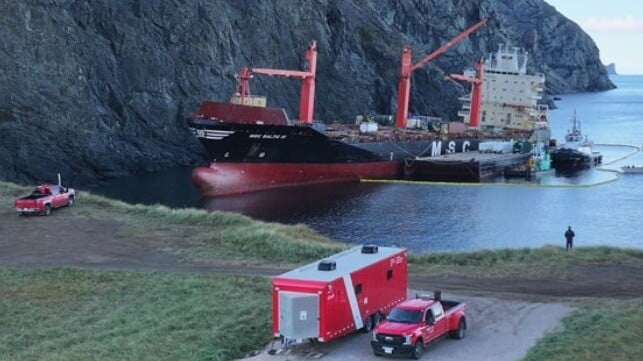
Newfoundland, Canada — Salvage operations on the grounded containership MSC Baltic III continue eight months after the vessel was driven ashore during a severe winter storm on the west coast of Newfoundland in February 2025. Authorities and contractors are now working to stabilize the ship and complete cleanup operations before winter conditions worsen.
The 207-meter-long (679-foot) container vessel, with a deadweight of 33,767 tonnes, ran aground in Cedar Cove after being forced ashore by strong winds and heavy seas. A dramatic helicopter rescue in storm conditions brought the crew to safety. Subsequent surveys revealed hull cracks, prompting an urgent decision to remove all remaining fuel and cargo from the ship.
At the time of grounding, the MSC Baltic III carried approximately 1.7 million liters of heavy fuel and marine gas oil and 470 containers, roughly half of which were empty.
Fuel Removal and Tank Cleaning
According to the Canadian Coast Guard, almost all fuel has now been extracted from the ship’s tanks. The process required heating and pumping the oil to a deck tank, then transferring it to a barge alongside. The recovered fuel was later offloaded to other MSC vessels calling at Corner Brook.
Cleanup teams are now concentrating on flushing and cleaning the tanks to remove any residual oil. The contents of the slop tanks have already been transferred to the deck and are being prepared for offloading.
Bruce English, who is overseeing the operation for the Canadian Coast Guard, told The Telegram newspaper that crews are working against time limits imposed by approaching winter.
“We won’t be able to complete the flushing one hundred percent before the cold weather,” he said, adding that residual cleanup remains ongoing as conditions allow.
Container Removal and Hazards
The salvage team contracted by MSC has removed 407 containers from the vessel. However, several remaining containers pose challenges. Some have been damaged or deformed due to water ingress, while others are too heavy to lift using the ship’s crane after becoming waterlogged.
Several containers also held decomposed food cargo, releasing toxic gases and further complicating onboard operations.
English noted that if weather conditions permit, the team may cut open some of the remaining 65 containers to reduce risks and weight. He stressed, however, that oil removal remains the top priority. Any further container handling would require a barge with splash guards to prevent contamination during transport.
Preparing the Vessel for Winter
In preparation for the harsh conditions expected in the North Atlantic, crews have begun flooding some tanks to provide ballast and improve stability. The decision allows the ship to maintain limited movement, reducing stress on the damaged hull. Engineers fear that if the vessel becomes too rigid, winter waves and ice could worsen structural cracks.
Adverse weather continues to limit the number of working days available on site. To improve safety and access, workers have nearly completed installation of a shore-to-ship cableway system that will allow personnel to reach the vessel more safely and consistently.
Uncertain Future of the Vessel
English confirmed that the future of the MSC Baltic III remains undecided. The ship will stay grounded in Cedar Cove through the winter, with its long-term fate to be determined next year.
“It could still be refloated, or it may have to be dismantled here,” English said.
As of late October 2025, operations have shifted from cargo removal to securing the vessel for winter survival, marking the transition from active salvage to preservation efforts until conditions improve in the spring.