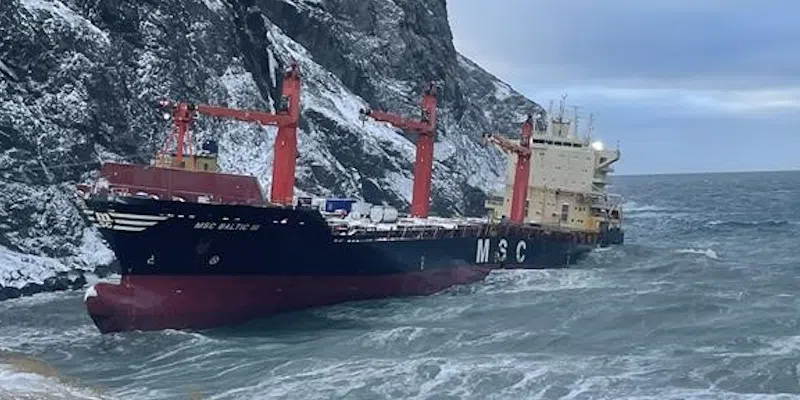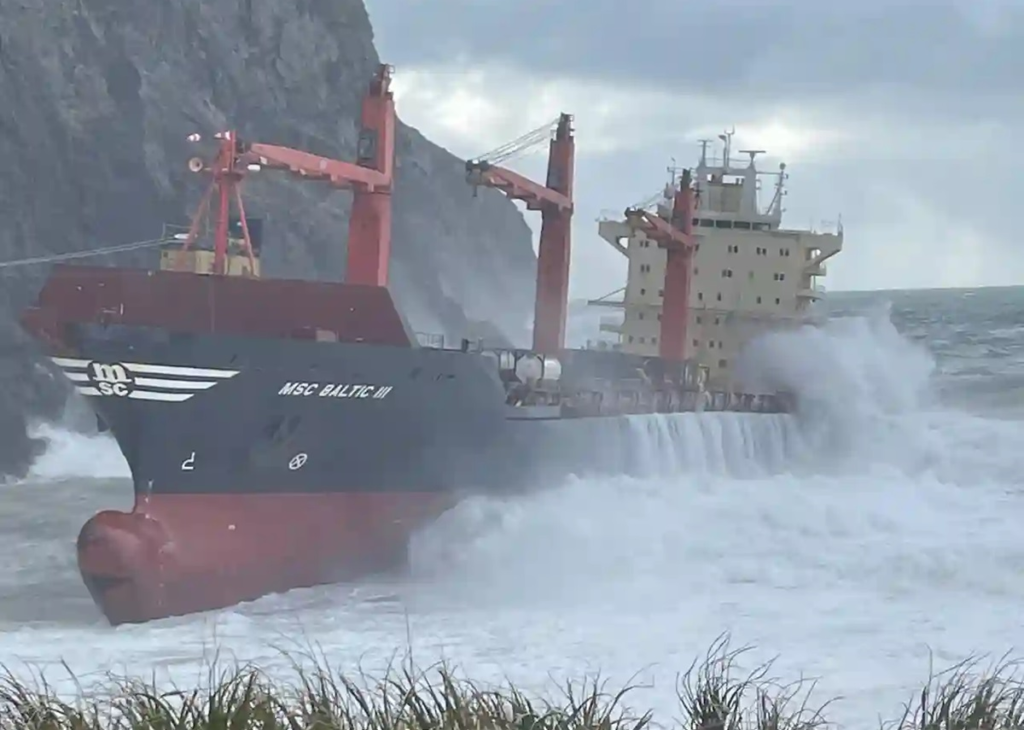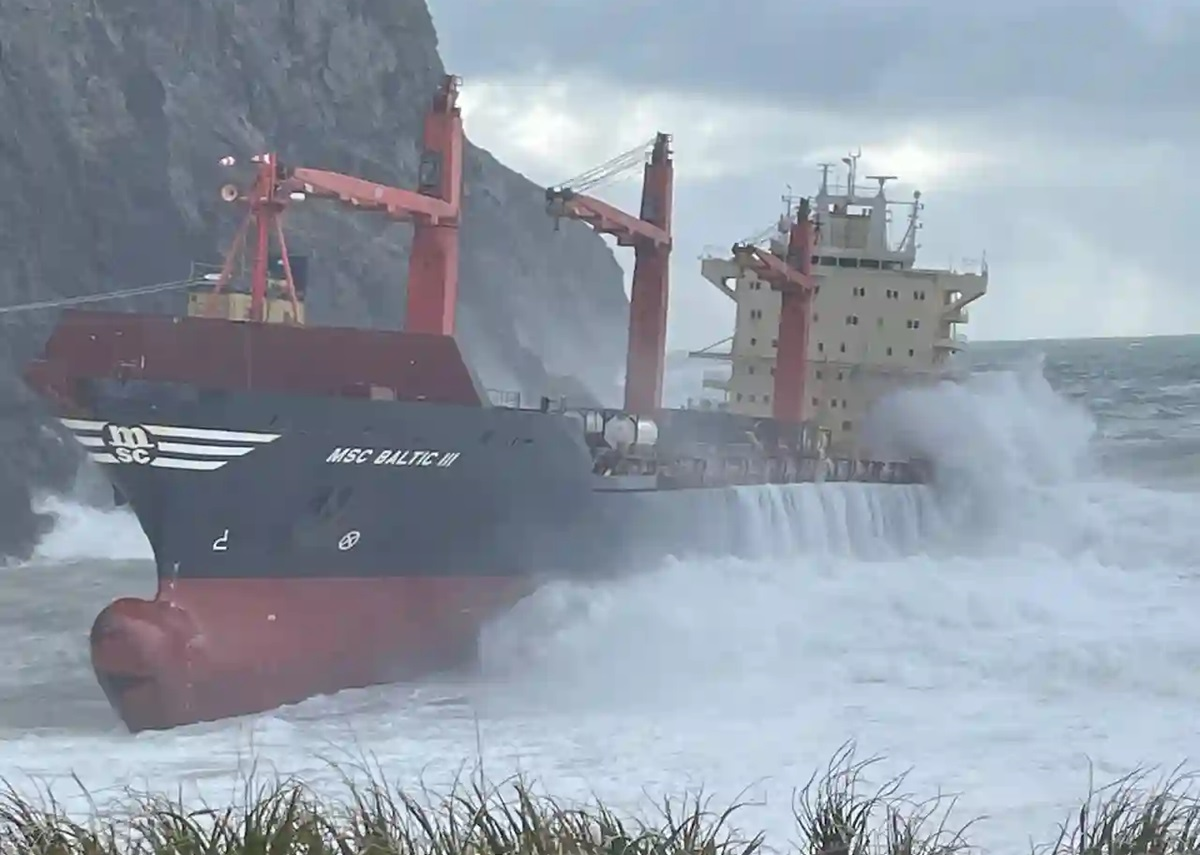
The Canadian Coast Guard has released new photos showing worsening hull damage on the MSC Baltic III, which has remained aground on a remote section of the Newfoundland coastline since February 2025. Heavy seas from major storms in early November and again in early December have further weakened the stranded vessel.
The same combination of winter weather and strong surf forced the ship ashore in February after it lost power while sailing to Corner Brook, Newfoundland. Canadian forces conducted a helicopter operation at that time to lift the crew off the vessel. Since the grounding on the rocky coast, the Coast Guard has maintained that removing the ship would be difficult. It is supervising work by T&T Salvage, contracted by MSC Mediterranean Shipping Company.
After the early November storm, the Coast Guard reported fresh structural damage in several locations, including spaces below deck, the ship’s framing and bulkheads near a water ballast tank. Expecting harsher winter conditions and increased risks to the grounded hull, salvage teams had already decided earlier in the autumn to load additional ballast water into the ship to help keep it stable through the winter period.
Access arrangements have also been adapted. A cableway from shore has been installed to allow personnel and equipment to reach the wreck from land, easing the previous reliance on sea approaches that were more exposed to weather and sea state.
The MSC Baltic III faced another round of severe winter conditions on 5 and 6 December. Coast Guard and salvage personnel boarded the vessel on 7 and 8 December to review the latest storm damage. According to their assessment, the hull has suffered further deterioration, with steel plating on both the starboard and port sides showing increased buckling. The stern section now sits noticeably lower in the water, and several items of light salvage gear on board were also found damaged.
Teams attempted a shoreline inspection, but poor conditions limited their work. Small amounts of oily debris have been recovered, and after the most recent period of bad weather, a tar ball was also reported.
In September and October, the operation concentrated on cleaning the fuel tanks and taking out the remaining oil from the ship. By early September, crews had removed 1,665.7 cubic meters of heavy oil and other contaminants. A number of containers were still in flooded holds. Rotting foodstuffs in some of the cargo led to fluctuating hydrogen sulfide levels, requiring additional safety measures for personnel on site. Flooding also slowed the clearance of the remaining containers, as the spaces had to be dewatered in a controlled way to avoid releasing more pollution. By late September, the Coast Guard said 65 containers were still on board, all located below deck and submerged.
As severe conditions ease, Coast Guard and salvage teams plan to reboard the vessel to carry out further damage surveys and to continue collecting debris washing off the hull. The Coast Guard expects winter storms to continue affecting the area and has said it will issue further updates if additional damage occurs. It has long been expected that removing the vessel would be difficult, and the growing extent of the damage is increasing the likelihood that the MSC Baltic III will be scrapped in place.