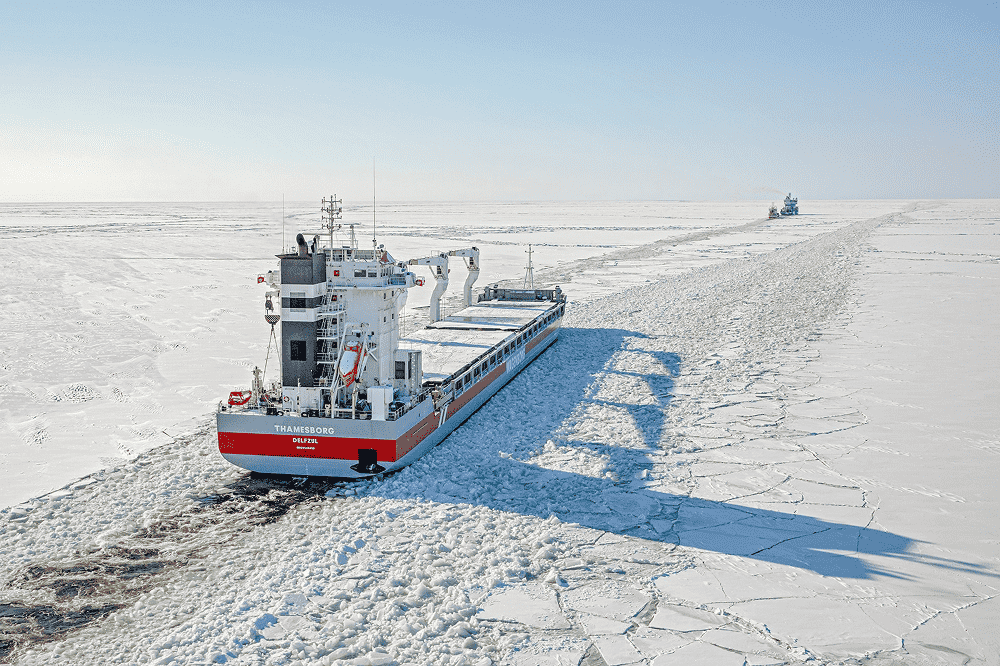
After six weeks of complex salvage and inspection efforts in the Canadian Arctic, the Dutch cargo ship Thamesborg has finally been refloated and departed safely through the Northwest Passage, escorted by support vessels toward the North Atlantic.
The ship, owned by Royal Wagenborg, was successfully refloated after cargo was reloaded and flooded ballast tanks were drained using specialized pumping systems. Once stabilized, the vessel moved to Wrottesley Inlet for safety checks and final assessments before resuming its voyage.
The Thamesborg’s route through the Bellot Strait, a narrow and rarely used channel connecting the Gulf of Boothia with Brentford Bay, offered a faster but riskier path out of Arctic waters. The 13.5-nautical-mile strait is known for unpredictable tides and strong cross-currents, requiring precision navigation and timing.
According to maritime authorities, the ship’s passage at an average speed of 9 knots was coordinated with tidal windows to minimize current impact. The decision to take Bellot Strait instead of the broader Barrow Strait likely aimed to avoid early ice formation as the Arctic season transitions into winter.
The Thamesborg is now en route to Baie-Comeau, Canada, and is expected to arrive around October 24, marking the end of one of the Arctic’s most challenging maritime recovery operations this year.
This incident highlights the growing logistical and environmental challenges of Arctic navigation, as shipping through the Northwest Passage becomes increasingly frequent due to climate-driven ice reduction.