Mitsui O.S.K. Lines, Ltd. (MOL) announced that onboard trials using its LNG-fueled vessel achieved a 98% reduction in methane slip, significantly exceeding its initial reduction target of about 70%.
The trials are part of Japan’s Green Innovation Fund Project, managed by the New Energy and Industrial Technology Development Organization (NEDO) under the “Next-Generation Ship Development Project.” The initiative is being jointly implemented by MOL, Kanadevia Co., Ltd., and Yanmar Power Solutions Co., Ltd.
From Land-Based Testing to Full-Scale Onboard Verification
MOL and its partners first conducted land-based engine tests, confirming a 93.8% reduction in methane slip under 100% engine load.
Building on these results, the system was installed on an LNG-fueled vessel for onboard verification during FY2025.
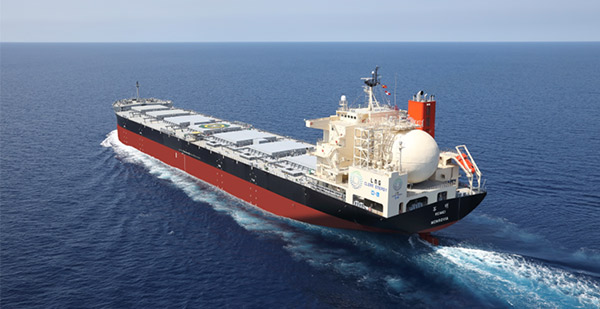
The test vessel, the LNG-fueled coal carrier REIMEI, demonstrated stable methane reduction performance under actual operational and environmental conditions.
At approximately 75% engine load, the system achieved a 98% reduction, exceeding laboratory test results.
This technology addresses one of the key environmental challenges of LNG propulsion — methane slip, or unburned methane emitted from engines — a critical factor in the maritime sector’s greenhouse gas profile.
Toward Commercialization in FY2027
MOL will continue the onboard demonstration through FY2026, with commercial application targeted for FY2027.
Based on the trial results, the company aims to further improve the operational efficiency and practicality of the system, contributing to the decarbonization of LNG-fueled shipping.
Working in collaboration with Kanadevia and Yanmar Power Solutions, MOL intends to accelerate the practical implementation of low-emission propulsion technologies within Japan’s maritime sector, in line with international decarbonization goals.
According to MOL, this achievement represents “a significant step toward real-world decarbonization in maritime operations,” reinforcing the company’s commitment to reducing greenhouse gas emissions across its global fleet.