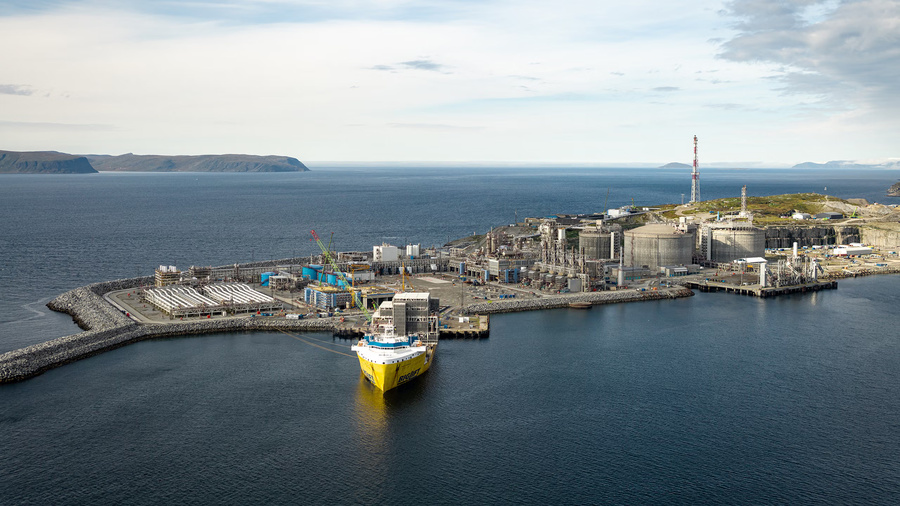
Equinor has increased the estimated cost of its Snøhvit Future project in northern Norway to NOK 26.5 billion ($2.8 billion) in 2026 value, while maintaining the planned commissioning dates for onshore compression and electrification at Hammerfest LNG.
The revised investment estimate was submitted to Norway’s Ministry of Energy in connection with the government’s proposed national budget for 2027. According to Equinor’s official announcement, onshore compression remains scheduled for 2029, followed by electrification in 2030.
The project is approximately 60% complete. A major compressor module was put in place at Melkøya in August 2026, while a steam boiler module is expected to arrive in spring 2027.
Construction activities also include a new substation at Melkøya, a subsea power cable and a 3.2 km power cable tunnel linking Meland and Hyggevatn.
Snøhvit Future comprises two developments at the existing Hammerfest LNG facility on Melkøya. Onshore compression is designed to help maintain gas production as reservoir pressure declines, while electrification is expected to reduce annual carbon dioxide emissions by approximately 850,000 tonnes.
The latest cost revision follows an earlier increase announced in December 2025, when the investment estimate exceeded NOK 20 billion in 2025 value. The project was originally estimated at NOK 13.2 billion when its plan for development and operation was submitted in 2022. That original estimate is equivalent to NOK 15.2 billion in current value.
Equinor identified several factors behind the additional costs, including operational challenges at Hammerfest LNG, adverse weather conditions and difficult rock conditions encountered during construction of the power cable tunnel.
The company also acknowledged that carrying out major construction and equipment integration work at an operating LNG facility has proved more complex than originally anticipated.
Equinor said it is working with suppliers on targeted measures, risk management and coordination with existing plant operations as construction continues.
The Snøhvit partnership consists of Equinor Energy AS, holding 36.79%, Petoro AS with 30%, TotalEnergies EP Norge AS with 18.4%, Vår Energi ASA with 12%, and Harbour Energy Norge AS with 2.81%.
Despite the higher investment estimate and ongoing construction challenges, the project’s current commissioning schedule remains unchanged.