deugro has completed the transport of more than 600 tonnes of high-voltage direct current (HVDC) cables from Sweden to Germany for the ElbX river crossing, part of TenneT Germany‘s SuedLink electricity transmission project.
The operation, carried out on behalf of cable manufacturer NKT, involved three cable baskets containing continuous cable sections exceeding five kilometres in length. The shipment required a combination of heavy-lift shipping, pontoon transport, a floating crane and self-propelled modular transporters (SPMTs).
The cables were manufactured at NKT‘s Karlskrona facility in Sweden for installation beneath the River Elbe. NKT confirmed on 12 November that the specially engineered 525 kV HVDC cable sections had been manufactured and delivered.
Because the ElbX crossing requires uninterrupted cable lengths without intermediate joints inside the tunnel, conventional cable drums could not be used. Instead, the cables were wound into three specially designed baskets for transportation.
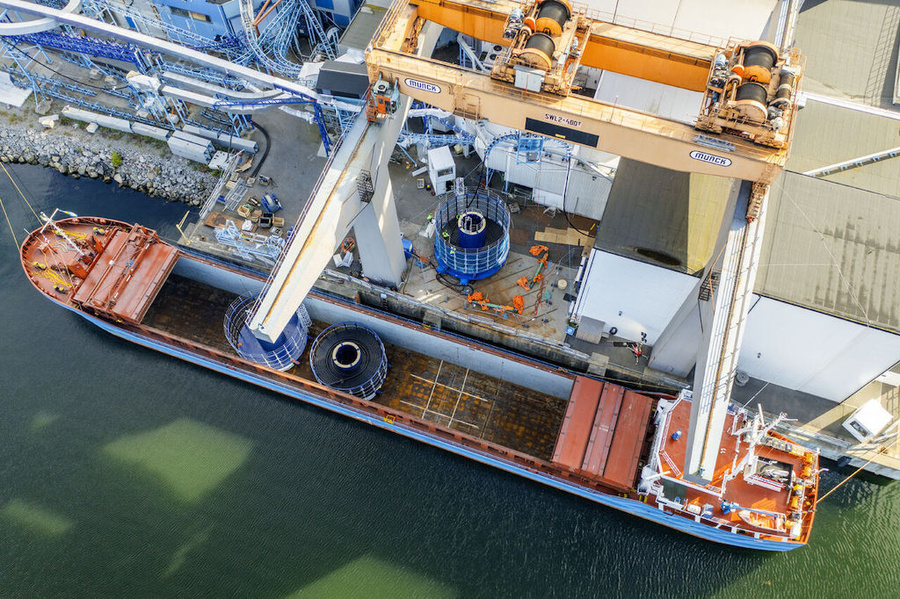
To accommodate the production and loading schedule, deugro chartered a coaster that remained at Karlskrona for approximately two and a half weeks. The vessel served as temporary floating storage while the cable baskets were prepared.
As each basket was completed, it was transferred onto the coaster using the factory’s gantry crane. Once all three were ready, the cargo was transferred directly from the coaster to a chartered heavy-lift vessel through double-banking operations.
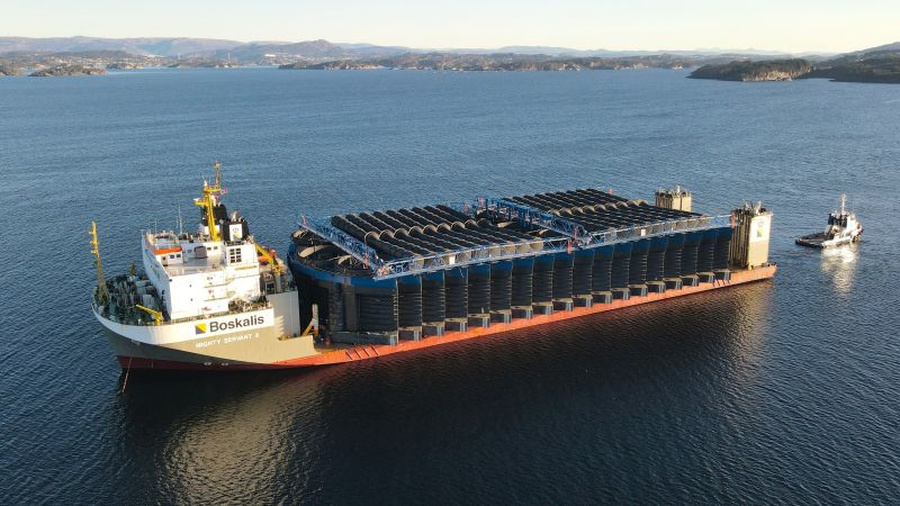
The heavy-lift vessel was equipped with two onboard cranes, each rated at 150 tonnes. After the baskets had been loaded and secured, the vessel departed for Brunsbüttel, Germany, completing the sea passage in approximately 24 hours.
The final delivery to the ElbX construction site required a separate transport arrangement. deugro assessed several road routes but identified constraints involving ground conditions, infrastructure restrictions and the load-bearing capacity of certain sections.
The company subsequently selected a multimodal approach that reduced the distance requiring heavy-haul road transportation.
From Brunsbüttel, the cable baskets were transferred onto a pontoon and moved by tugboats to Peters Werft in Wewelsfleth, close to the ElbX construction site.
A floating sheerleg crane accompanied the pontoon for the unloading operation. At the destination, the baskets were lifted directly from the pontoon onto SPMTs and moved to the designated staging area.
The operation required coordination around wind, weather, tidal conditions, water levels and quay load capacity. Representatives of NKT, TenneT Germany, deugro and dteq monitored the transport and unloading activities.
In an update published on 9 October, WTM Engineers, which is involved in planning and supervising the ElbX crossing, confirmed the arrival of the first three cable baskets and their onward movement by SPMTs.
ElbX forms the approximately 5.2-kilometre tunnel crossing beneath the River Elbe between Schleswig-Holstein and Lower Saxony. It is part of SuedLink, which is intended to carry electricity from northern Germany to major consumption centres in the south.
According to NKT‘s 12 November announcement, the delivered cables will next be pulled through the tunnel using specialised installation equipment before being connected to the wider SuedLink transmission system.