Mexican authorities are pressing ahead with cleanup work along the Gulf coast while continuing efforts to identify the tanker they suspect was responsible for the oil discharge detected earlier this month.
The government said Pemex was not behind the spill. President Claudia Sheinbaum said authorities had determined that the state oil company was not responsible after the release was found offshore in the Gulf of Mexico on 4 March. Since then, Pemex has worked with the navy and other government agencies on the response.
Federal authorities said the investigation has included patrols, satellite monitoring, ocean current analysis, and field inspections to trace the source of the contamination. Their working view is that the discharge came from an offshore anchorage near the Pajaritos petrochemical facility in Coatzacoalcos, located in southern Mexico between Tabasco and Veracruz. The authorities said they would continue efforts to identify the vessel and pursue action under environmental legislation.
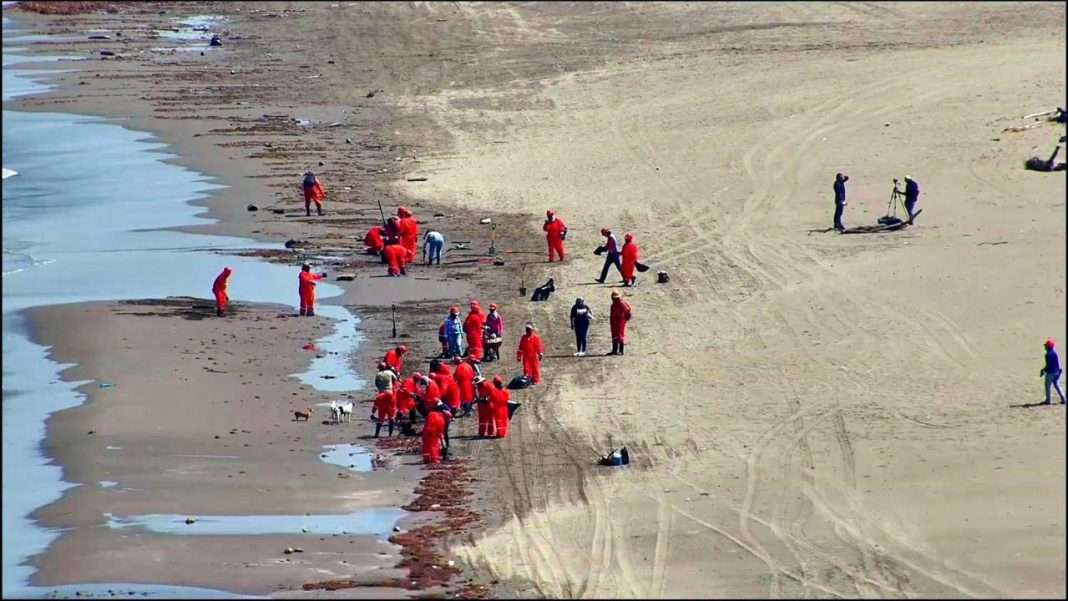
Containment work was carried out by the navy and Pemex during the first stage of the response. By 14 March, the government said containment had been completed and the operation had shifted to shoreline cleanup. Specialized vessels were also deployed to help stop the pollution from spreading in an area that supports tourism and local fishing.
Environmental authorities reported 91 tonnes of hydrocarbon-soaked waste had been collected by 16 March. They later said the operation was 85% complete, before revising the figure to 88% by Thursday, when 94.7 tonnes had been collected and stored for analysis. By Saturday, officials reported a further 240 kg of soaked material had been recovered, but no updated completion estimate was given.
In Tabasco, cleanup teams collected 80 m³ of waste at Ejido Sinaloa, 30 m³ at Arroyo Verse, and 10 m³ at Manatinero. In Veracruz, the shoreline response began on 5 March, with 210 workers deployed along more than 225,000 m of coastline. Authorities said 40 tonnes were collected at Barrillas Beach, 20 tonnes at Linda Beach, and 30 tonnes at Jicacal Beach.
Environmental groups said they remain concerned that more oil may still be offshore. They warned that the contamination had already reached the breeding area for fish, shrimp, and clams in Ostion lagoon in Veracruz, and noted that sea turtle nesting season begins in April.