
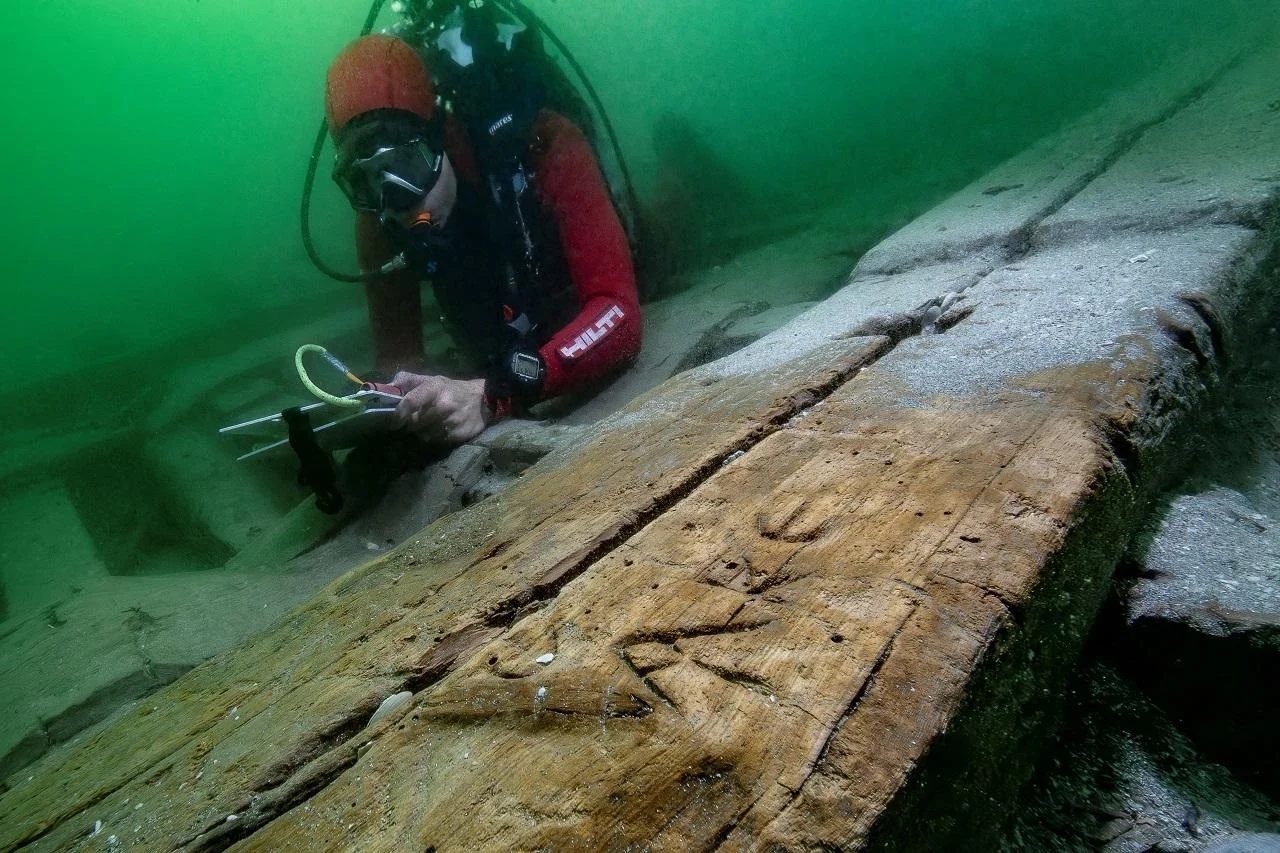
Archaeologists working in Alexandria’s ancient harbor, now submerged, have uncovered the remains of a rare luxury vessel long known from classical texts but never before identified on the seabed: an Egyptian pleasure barge, or thalamagos. The wreck was located off the submerged island of Antirhodos, once within Alexandria’s Portus Magnus, during underwater work directed by the European Institute for Underwater Archaeology (IEASM).
The team has exposed a series of exceptionally preserved wooden timbers about 28 m in length from a hull originally measuring roughly 35 m long and 7 m across. The lines of the vessel show that it was built with an unusually broad beam to allow room for a central pavilion and an ornate cabin structure. Its flat bottom, sharp chine at the bow and rounded stern point to a highly specialized design for quiet, shallow waters rather than open-sea voyages. Researchers say the barge relied entirely on oars and would have required more than 20 rowers.
Greek graffiti on the boat’s central superstructure place it in the early first century CE and indicate that it was built locally in Alexandria. This dating fits with the writings of the geographer Strabo, who had visited the city a few decades earlier and described cabin-boats used for festivals, leisure outings and religious events along canal banks dense with vegetation.
The wreck lies less than 50 m from the remains of the Temple of Isis, which is also under excavation. Based on the barge’s location and age, one line of research links its loss to a destructive episode around CE 50, when earthquakes and tidal waves caused major sections of Alexandria’s waterfront, palaces and sanctuaries to collapse into the sea. Another interpretation suggests a ritual role: the vessel may have been attached to the Isis sanctuary and used in the annual navigium Isidis, a ceremonial waterborne procession reenacting the goddess’s solar journey toward Canopus.
Vessels of this general type appear in ancient images, including the well-known Nile mosaic of Palestrina, but the newly documented barge is considerably larger than most of those scenes. The find also echoes literary accounts of the Ptolemaic rulers’ floating palaces, including those associated with Cleopatra VII, underscoring a long Egyptian tradition of ceremonial and pleasure craft.
Study of the wreck is only beginning, and under UNESCO rules the structure will be left on the seabed to aid preservation. Excavations around the site are expected to continue and are likely to provide further information on daily routines, religious practice and elite leisure in early Roman Alexandria. The scientific results from work at the Temple of Isis in Alexandria’s Portus Magnus have recently been released by the Oxford Centre for Maritime Archaeology.
