The Pulau Tekong Polder development, a major addition to Singapore’s reclaimed land portfolio, moved forward as twelve heavy barges were extracted from an inland pond and transferred back to open water for continued use. The works form part of the country’s first empoldering venture, led by the Housing Development Board (HDB) and delivered by the Boskalis Penta Ocean Joint Venture (BPJV).
Unlike sand-based reclamation, the polder system encloses land with a dike and then lowers the internal water level through controlled drainage. This setup reduces the volume of fill required for construction. Within this new tract, a stormwater pond was built to regulate runoff, and floating equipment was deployed to shape the basin. Once the excavation campaign ended, these units became landlocked and had to be removed for redeployment.
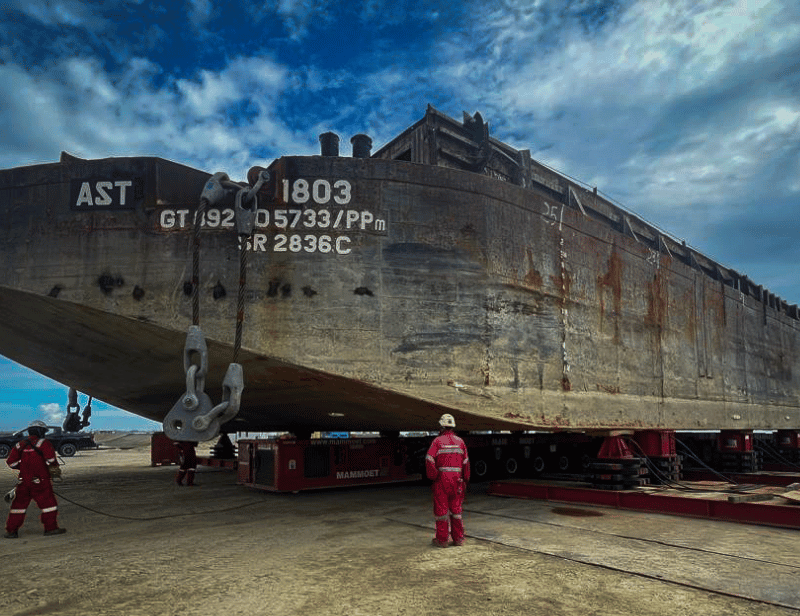
Each barge weighed between 680t and 990t, and relocating them required retrieval from the pond, movement across the newly completed haul route, and re-entry into the sea. Because of this multi-stage scope, the client appointed Mammoet, drawing on the company’s broad experience with airbag and winch solutions for marine handling.
A combined team of specialists was mobilized to plan and execute the sequential operations. For every barge, crews positioned 68 airbags, then connected cables to four winches rated between 60t and 85t. The winches hauled the bow clear of the pond, after which 18 climbing jacks lifted the hull so the airbags could be removed. Once elevated, SPMTs (Self-Propelled Modular Transporters) were placed under the structure and used to transfer the vessel to the designated launch point.
Setting each barge afloat required repeating the initial steps in reverse order. All twelve units were handled using this cycle. Weather presented challenges, but the team maintained the project timeline and enabled a critical stage of the larger polder works, supporting Singapore’s land expansion initiative.
“We take immense pride in our role within the Tekong Polder project. By leveraging our global expertise, we helped enhance Singapore’s geographical footprint,” said Anandan Lokantham.