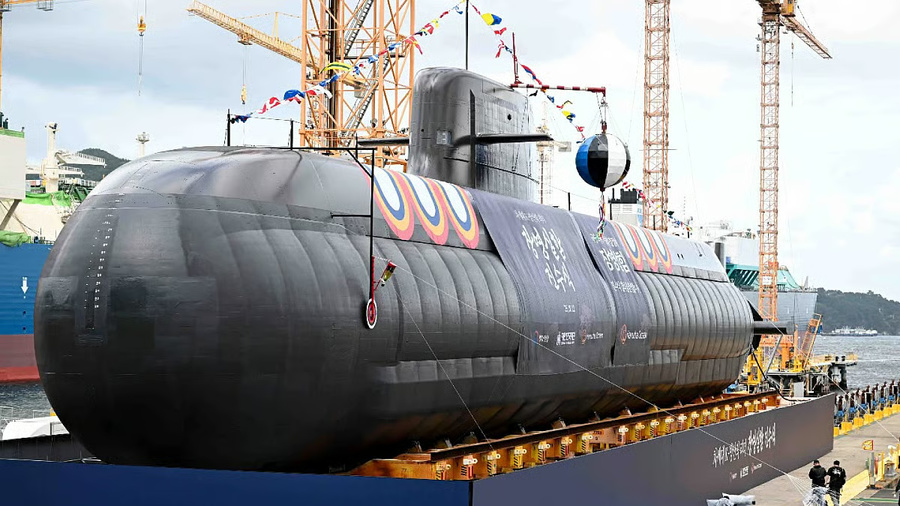
South Korea has approved the basic acquisition strategy for its Jang Bogo N nuclear submarine programme, clearing the way for competitive bidding among domestic shipbuilders and a planned contract award in 2027.
The Defense Acquisition Program Administration (DAPA) confirmed that the decision was made at the 179th Defense Acquisition Program Promotion Committee meeting, held at the Ministry of National Defense on 6 November 2026.
The programme, officially designated KSS-III Batch-III, aims to develop and build nuclear-powered, conventionally armed attack submarines in South Korea.
Under the approved procurement arrangement, a domestic shipbuilder will be selected through competitive bidding to undertake hull development, construction and systems integration. The government will separately develop or procure the submarine’s small modular reactor (SMR) propulsion system and selected major weapons, including key missile systems, and provide them as government-furnished equipment.
DAPA said preliminary research had established that domestic shipbuilders possessed sufficient submarine design and construction capabilities to justify competitive procurement rather than a sole-source contract.
The agency plans to prepare a basic system development plan in the first half of 2027, followed by a tender announcement, proposal evaluations and contract negotiations. It aims to select a prime contractor and conclude a contract before the end of 2027.
The programme was exempted from the standard feasibility study in August under provisions allowing exceptions for defence acquisitions requiring exceptional security. The study normally takes one to two years, although a separate in-depth review will still be conducted.
The total programme budget remains undetermined. South Korean media have reported an estimated cost of approximately KRW28.9 trillion, but DAPA said detailed cost analysis was still underway.
The government’s proposed 2027 defence budget includes KRW96.6 billion for the nuclear submarine programme, covering initial development-related expenditure.
South Korea aims to launch the lead submarine in the mid-2030s and begin operational deployment in the late 2030s or later.
Reports have indicated plans for three submarines of approximately 8,000 tonnes each. However, the final number of vessels, detailed specifications and weapons configuration have not been officially confirmed.
Nuclear fuel procurement remains a separate issue. The submarines are intended to use low-enriched uranium with an enrichment level below 20%, but South Korea has yet to secure a final fuel supply arrangement with the United States.
Bilateral discussions began in June 2026, but a second round had not taken place when the acquisition strategy was approved.
South Korean defence officials have indicated that a separate agreement with Washington, potentially following the approach used for Australia’s AUKUS nuclear submarine programme, could be considered instead of revising the existing civilian nuclear cooperation agreement.
DAPA has also acknowledged that proceeding with a domestic construction contract before the fuel arrangements are finalised would require policy and political consideration.
The approval follows the government’s initial Jang Bogo N development plan, announced in May 2026, which established the programme’s objectives and indicative development schedule.
According to DAPA’s official announcement, the nuclear-powered submarines are expected to strengthen South Korea’s ability to deter North Korean nuclear and missile threats and support its underwater Kill Chain capabilities.