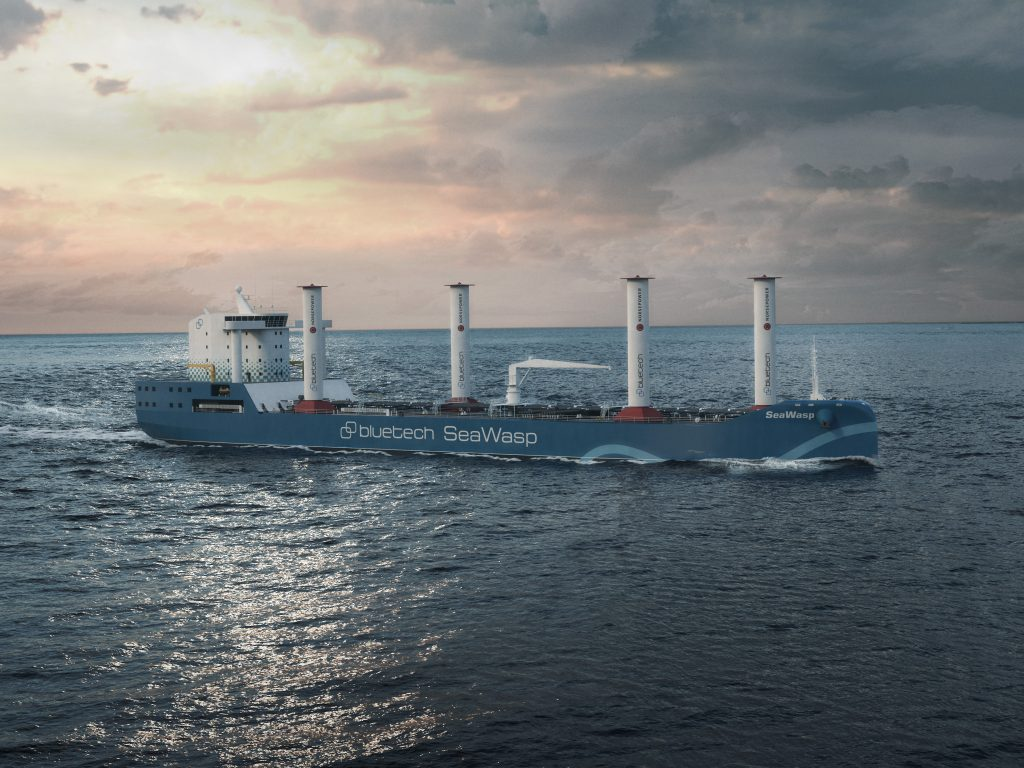
Norsepower and Bluetech, working with NYSE-listed INSW, shared simulation findings from the SeaWasp MR tanker concept, focusing on how wind-assisted propulsion performs when the vessel is designed around it rather than treated as a retrofit.
On a representative San Francisco–South Korea run, two 35 m × 5 m Norsepower Rotor Sails delivered an average propulsion contribution of 876 kW, described as equivalent to about 597.2 tonnes of fuel saved per year. The partners also reported that hull-and-arrangement changes in the concept accounted for up to 13.5% of the total fuel savings in certain conditions.
The study also tested less favourable winds. On the South Korea–Singapore route, the concept still showed potential savings of 185.9 tonnes of fuel. Bluetech said its BT50 baseline was approximately 12% more efficient than typical tanker performance profiles in the sample fleet, with further gains linked to aerodynamic shaping above the waterline and a CFD-assessed fin system branded “blueSURF” below it.
Configuration checks indicated four 24 m × 4 m Rotor Sails were marginally better in this specific case, while the two 35 m × 5 m set-up offered the highest overall savings potential at lower cost. Norsepower added that larger savings and emission reductions were expected through Norsepower Sentient Control, its data-driven control system.