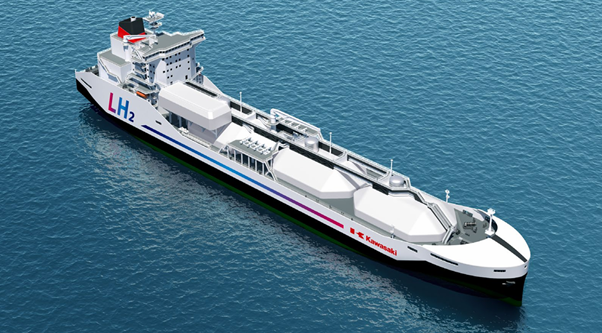
Kawasaki Heavy Industries, Ltd. and Japan Suiso Energy, Ltd. (JSE) announced on 6 January 2026 that they signed a contract for an LH2 carrier with a cargo tank capacity of about 40,000 m3, described as the largest in this segment. The vessel will be built at Kawasaki’s Sakaide Works in Sakaide City, Kagawa Prefecture.
JSE will act as project operator under the NEDO Green Innovation Fund project for a liquefied-hydrogen supply-chain commercialization demonstration. The plan is to demonstrate ship-to-base loading and unloading of liquefied hydrogen by FY2030 and to conduct trials under ocean-going conditions.
The companies linked the contract to earlier steps in LH2 transport development. In 2021, Kawasaki built the 1,250 m3 liquefied-hydrogen carrier SUISO FRONTIER and established the “Hy touch Kobe” receiving demonstration terminal. In February 2022, Kawasaki participated—through HySTRA—in a pilot demonstration covering loading, unloading, and transportation of liquefied hydrogen between Japan and Australia. The newbuild is positioned as a foundation asset for a future hydrogen supply chain.
For the demonstration programme, JSE will use the vessel together with the Kawasaki LH2 Terminal, a liquefied-hydrogen base now under construction at Ogishima in Kawasaki City, to verify performance, safety, durability, reliability, and economics required for commercialization.
The design features include cargo tanks totaling around 40,000 m3 and a high-performance insulation system to reduce boil-off gas (BOG) generated by natural heat ingress. The electric propulsion arrangement combines a hydrogen/oil dual-fuel generator engine with a conventional oil-based generator engine. A hydrogen gas supply system with a compressor and heat exchanger enables BOG from the cargo tanks to be used as a propellant, reducing CO2 emissions during liquid-hydrogen transport. The vessel is also equipped for large-volume cargo handling, with double-wall vacuum-jacketed piping for efficient transfer between shore facilities and onboard tanks at extremely low temperatures. Hull shape and draft reflect liquefied hydrogen’s low density to reduce required power and improve propulsion efficiency. Hydrogen fuel, fuel-supply, and cargo-handling systems have been risk assessed and safety measures adopted to protect crew, the environment, and the vessel’s structural integrity.
Principal particulars disclosed include: overall length approx. 250.0 m; molded breadth 35.0 m; molded depth 20.0 m; fully loaded summer draft 8.5 m; sea speed approx. 18.0 knots; diesel/hydrogen-fueled electric propulsion; class Nippon Kaiji Kyokai (ClassNK); country of registration Japan.