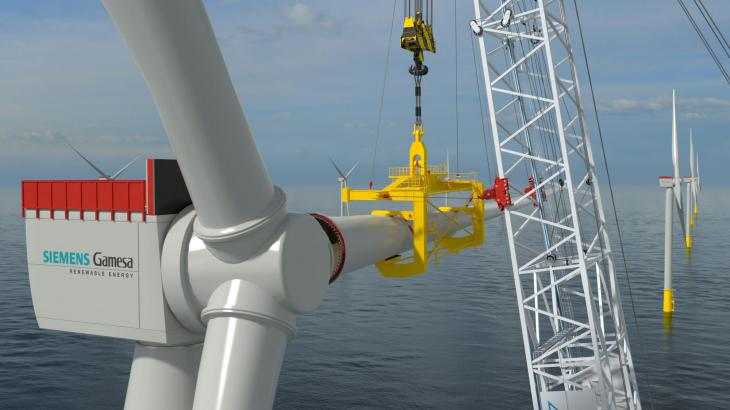
Huisman and Siemens Gamesa introduced a jointly engineered solution on 20 April 2023, combining their technical and operational expertise to stabilise wind turbine blades, nacelles, and tower segments during installation. The two companies developed the Travelling Load Stabilising System for improved control of lightweight components affected by wind while suspended from a crane.
The system utilises two pairs of tuggers operating together to manage load movement. One pair is mounted on independent trolleys that travel along an integrated rail on the crane’s stiff boom, automatically following the main block to maintain optimal line geometry. The second pair is deployed from the crane tip, providing a perpendicular force. By engaging the load from two directions, the configuration delivers significantly more control than a conventional single-pair tugger setup.
A dedicated control system holds the load’s position, offering greater stiffness and accuracy than constant-tension systems. In the event of an unexpected overload, the system yields within limits and returns to its setpoint once forces fall below the defined threshold.
Fully integrated into the crane, the Travelling Load Stabilising System can be operated from the crane cabin or via an optional walk-around box (WAB).
Jesper Moeller, Chief Engineer Execution at Siemens Gamesa, stated that the technology is essential for the technical readiness of next-generation wind turbine installation under challenging wind conditions. He added that increased installation uptime, improved overall operational activities, enhanced safety, and reduced (de-)mobilisation periods provide benefits across the wind industry.
Huisman CEO David Roodenburg highlighted the importance of industry cooperation in accelerating the energy transition. He noted that combining Siemens Gamesa’s operational knowledge with Huisman’s equipment expertise has resulted in a solution that reduces weather downtime, a persistent challenge during turbine installation.
Key features include optimal tugger elevation, high-stiffness boom trolleys, position-controlled winches, full integration with crane controls, suitability for lifting and man-riding operations, optional automation for specific tasks, and retrofit provisions in Huisman’s latest crane designs.