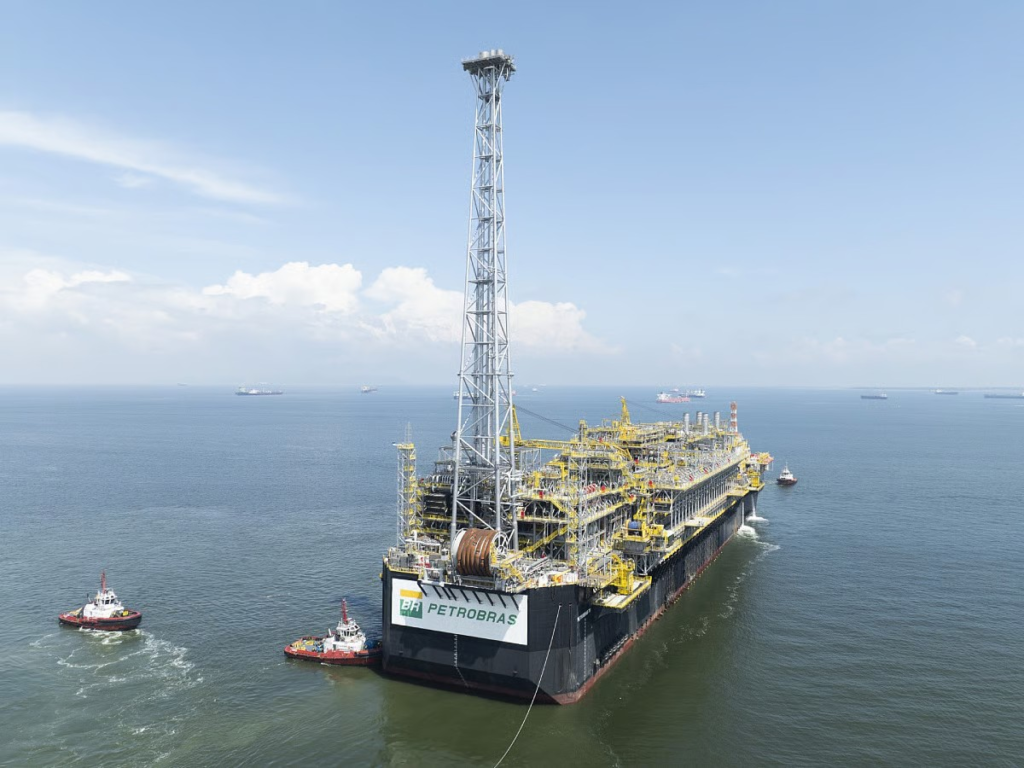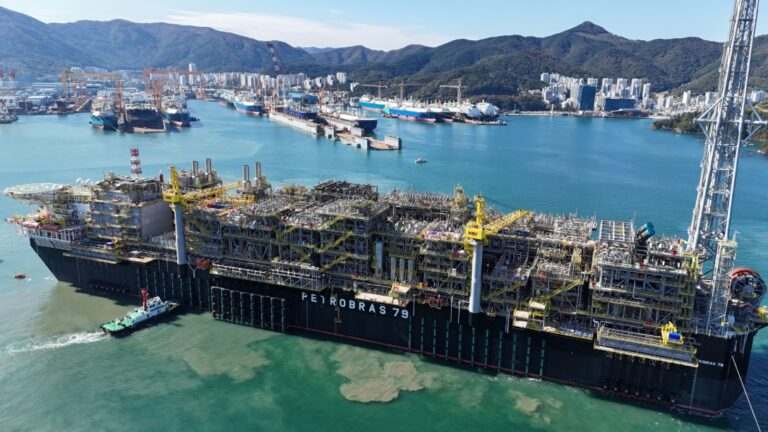
The FPSO P-79 has departed Hanwha Ocean’s shipyard in Geoje, South Korea, beginning its tow to the Búzios field in Brazil’s Santos Basin, according to Petrobras. The vessel left the yard on 11 November, with its crew on board, a measure the operator said had also been used for FPSO P-78.
Petrobras states that the unit is scheduled to arrive at Búzios in February 2026 and begin production in August 2026. The FPSO is designed to produce 180,000 barrels of oil per day and compress 7.2 million m³ of gas per day. The development plan for P-79 includes 14 wells, consisting of eight producers and six water-alternating-gas (WAG) injectors.
The company explains that P-79 is the eighth of twelve units planned for the field. Petrobras also notes that P-78, the seventh unit, is expected to start operations in December, and that these additions will increase installed capacity at Búzios by about 15.6%, reaching approximately 1.3 million bpd.
Renata Baruzzi, Director of Engineering, Technology and Innovation, said the approach used for P-79 and P-78 has reduced the time required to begin production, and added that detailed planning, supplier negotiations, and internal efforts contributed to the ability to bring first oil forward by about two months relative to the current Strategic Plan.
The Búzios field lies in ultra-deep waters of up to 2,100 m, around 180 km off the coast of Rio de Janeiro. It currently hosts six FPSOs: P-74, P-75, P-76, P-77, Almirante Barroso, and Almirante Tamandaré. The Almirante Tamandaré, operating since February 2025, recorded an instantaneous production flow of 270,000 bpd on 25 October 2025.
The P-78 departed Seatrium’s Benoi shipyard in Singapore on 13 July, arriving at Búzios on 30 September. In the following month, the field surpassed 1 million bpd, making it Petrobras’ largest producing field.