South Korean daily Chosun Ilbo reports that Chinese shipyards are stepping up capacity expansion during the current shipbuilding boom, prompting concern in the industry that global capacity could again tip into oversupply.
Citing the shipbuilding industry and overseas media on the 19th, the newspaper says Chinese yard Zhejiang Xinxinzhou Shipbuilding began work this month on a new smart shipyard valued at 1 billion yuan, or about 210 billion won. The project, cleared by Taizhou city authorities in September, is due to be finished in June 2027 and is set to lift the yard’s construction capacity by 300,000 DWT (deadweight tonnage).
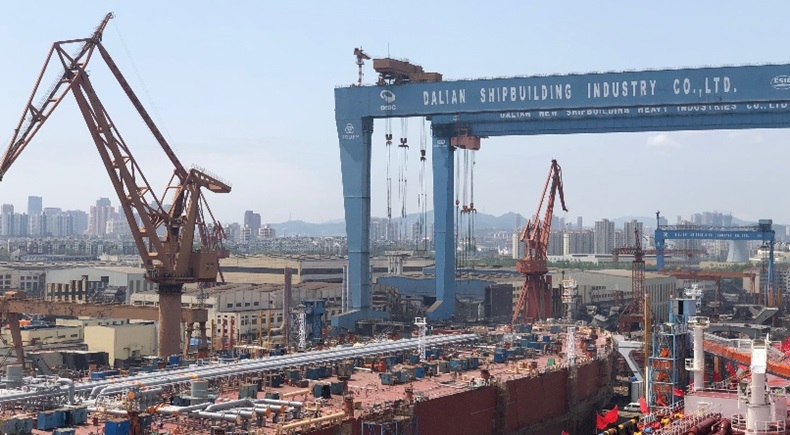
Chinese builder Hengli Heavy Industry, which acquired the Dalian shipyard from Korea’s STX Group in 2022, also pushes ahead with expansion. Early this year, it launched a so-called “future factory” project and, by June, had completed two large dry docks as part of the plan.
Further dock investments are underway at other major Chinese yards. Yangzijiang Shipbuilding, ranked fifth worldwide by order backlog, started adding a 300,000-tonne-class dock in the second half of last year. Another Chinese yard, New Times Shipbuilding, received approval in May to build a new dock of the same 300,000-tonne class.
Most of these new or expanded facilities are being developed as smart factories. According to Chosun Ilbo, Hudong-Zhonghua Shipbuilding completed and unveiled a new yard in May after spending 18 billion yuan—roughly 3.75 trillion won. The facility is described as offering advanced workspaces that use 5G networks, Internet of Things (IoT) systems, robotic welding, and big-data-based controls.
As these projects move forward one after another, the size gap between the Chinese and Korean shipbuilding industries is widening. Based on figures from Clarksons Research, the paper reports that the number of shipyards in China increased from 206 in 2023 to 217 as of last month, while Korea had 12 shipyards over the same period.
Clarksons Research data also show China’s share of global newbuilding orders continuing to climb. The country’s portion of worldwide orders rose from 55.9% in 2022 to 63.8% in 2023, and then further to 69.8% last year, according to the report.
At the same time, capacity growth is stoking worries about the market outlook. Clarksons Research expects shipbuilding supply and demand to remain in balance through 2027, but warns that if large-scale investments in new Chinese yards continue, oversupply could appear after 2028, Chosun Ilbo writes.
The newspaper notes that Korean shipbuilders are responding with a different strategy from China’s direct expansion of domestic yards. Rather than committing to large-scale capital spending at home, they are spreading risk through partnerships with overseas shipyards. HD Korea Shipbuilding & Offshore Engineering, for example, has pursued its expansion into India by working with Cochin Shipyard Limited, the country’s largest state-run yard.
In addition, Samsung Heavy Industries has subcontracted the construction of three crude oil carriers—ordered in Liberia, Africa, in October—to a shipyard in Vietnam. According to Chosun Ilbo, research fellow Lee Eun-chang of the Korea Institute for Industrial Economics & Trade (KIET) warns that if global shipbuilding conditions deteriorate and new orders fall, Korean shipbuilders, which face higher production costs than their Chinese rivals, are likely to suffer a greater impact.
Source: Chosun Ilbo