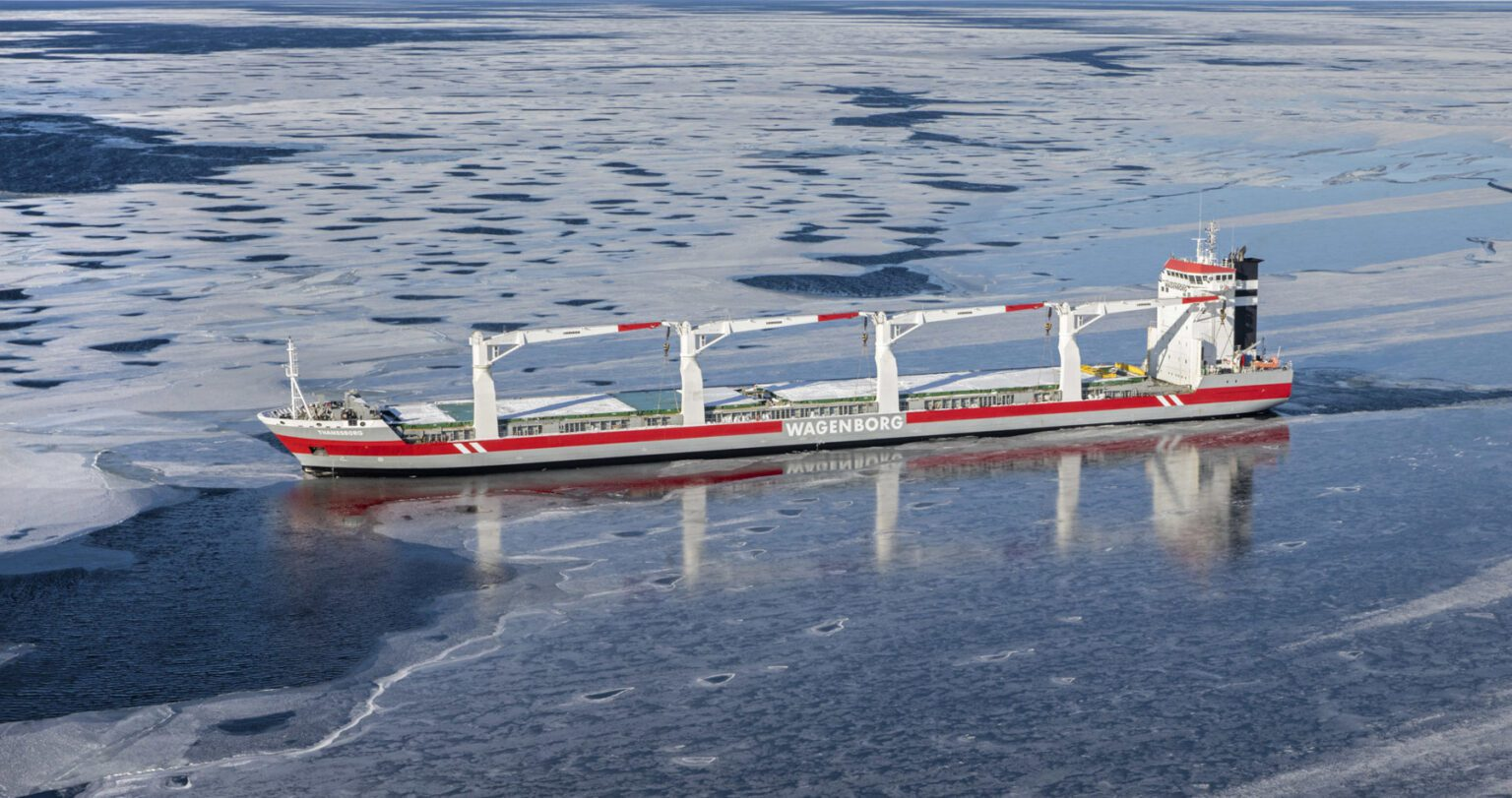
The Dutch general cargo vessel Thamesborg remains stranded in the Canadian Arctic nearly a month after it ran aground while transiting the Northwest Passage. The ship, operated by Wagenborg, was en route from Lianyungang, China, to Baie-Comeau, Canada, when it became stuck on a shoal on September 6.
An expanding team of vessels has gathered to assist the recovery. Over the weekend, the Finnish-built icebreaker Botnica arrived on site after sailing from Europe via Greenland, marking the fourth ship deployed to the operation. Earlier, the tug Beverly M I and the cargo ship Silver Copenhagen reached the scene to help offload Thamesborg’s cargo of carbon blocks. Another support vessel, Nunalik, also joined recently to take part in cargo transfers and logistical coordination.
The arrival of Botnica brings a much-needed boost in capability as sea ice begins to reform around the stranded vessel. With a bollard pull of roughly 117 tonnes, the icebreaker offers far greater towing power than the coastal tug on standby, giving responders a stronger chance to refloat Thamesborg before conditions deteriorate. Built in 1998, Botnica is typically employed for offshore support and ice management in the North Atlantic and Baltic Sea.
Authorities are aiming to refloat Thamesborg within the coming week, depending on weather and ice conditions. However, the onset of early freeze-up has raised concerns that the window for recovery is closing rapidly. The Canadian Ice Service reports that new ice has already begun forming in Barrow Strait to the north, and alternative escape routes—such as through Fury and Hecla Strait or westward via Amundsen Gulf—are being evaluated in case the main channel becomes impassable.
The incident underscores the challenges of Arctic shipping as the navigable season shortens. The Northwest Passage typically closes to commercial traffic around mid-October, although timing varies each year depending on ice buildup. If Thamesborg cannot be freed soon, it risks being trapped until next summer’s thaw.