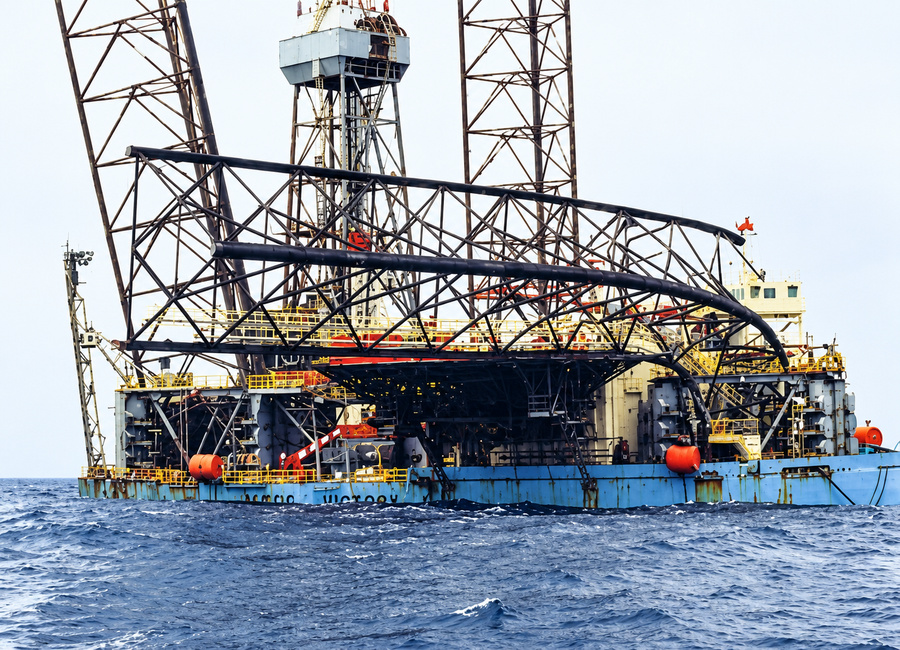
Nearly 30 years before Borr Drilling’s Prospector 5 sank offshore Gabon, another jack-up drilling rig suffered a serious punch-through during preloading. On 16 November 1996, Maersk Victory experienced a sudden seabed foundation failure in Australia’s Gulf St Vincent, causing extensive damage to all three legs and forcing the evacuation of its crew.
The two incidents occurred during jack-up installation, when the rigs were being prepared to withstand the loads expected during drilling. The causes and management failures behind the Maersk Victory accident were documented in an official South Australian investigation. In the case of Prospector 5, the causes of the sinking will need to be established through a detailed investigation.
The 1996 findings provide a detailed account of how inadequate seabed assessment, unexpected leg penetration and weaknesses in operational risk management preceded a major offshore drilling accident.
An exploration campaign in unfamiliar waters
The Maersk Victory, a MODEC 300C-35 jack-up delivered in 1981, was deployed to South Australia for a two-well exploration programme in Gulf St Vincent.
The campaign was undertaken under Petroleum Exploration Licence 53, held by Canyon (Australia) Pty Ltd, with Apache Energy managing drilling operations. Maersk Contractors supplied and operated the rig.
On 15 November 1996, Maersk Victory arrived in Gulf St Vincent aboard the semi-submersible heavy-lift vessel Super Servant 3 after a voyage from Dampier, Western Australia.
The rig was discharged at approximately 20:00 and subsequently towed towards the Frijole No. 1 exploration well using the support vessels Massive Tide and Canning Tide.
The location had not previously been used for jack-up drilling operations, and the load-bearing properties of the seabed sediments had not been adequately established.
A site investigation conducted by Fugro included side-scan sonar, shallow seismic profiling and seabed sampling. However, the physical samples penetrated less than 1 m below the seabed.
Although the survey identified relatively flat seabed conditions and sediments considered potentially suitable for supporting the rig, it did not provide sufficient geotechnical information to establish foundation capacity under the anticipated loads.
Missing survey information and unexpected penetration
During the tow to the drilling location on 15 November, personnel discovered that the complete site survey report was not available aboard Maersk Victory.
A request was made to bring the document to the rig by helicopter, but the scheduled flight was cancelled because of weather conditions.
Early on 16 November, the rig’s three legs were lowered onto the seabed. After an initial positioning check, the unit was moved closer to the well location using a procedure known as walking, in which selected legs were alternately raised while the rig pivoted on the remaining legs.
At 06:30, jacking operations began to lift the hull clear of the water.
The expected leg penetration specified in the Certificate of Approval was approximately 2.0–2.5 m. Actual penetration proved substantially greater.
At 07:12, when the hull first cleared the water, the recorded penetration depths were 9.4 m for leg No. 1, 7.2 m for leg No. 2 and 9.2 m for leg No. 3.
Shortly afterwards, leg No. 2 settled a further approximately 2 m.
The crew lowered the hull using the other two legs to restore its level position before resuming jacking operations.
The TowMaster also attempted to obtain advice from Maersk’s Copenhagen office but was unable to secure additional guidance on the conditions encountered.
When the rig reached the required preload air gap of 2 m, leg penetrations stood at 9.9 m, 9.6 m and 9.6 m respectively.
Despite the considerable discrepancy between predicted and actual penetration, the operation continued towards preloading.
A critical decision before preloading
The unexpectedly deep penetration prompted personnel to request additional survey information from shore.
Relevant sections of the site survey, including shallow seismic data, were transmitted by fax. However, the personnel reviewing the information did not have professional qualifications in seismic interpretation.
The complete Fugro site survey eventually arrived by helicopter at 08:25 on 16 November, before preloading commenced.
Representatives from Maersk Contractors, Apache Energy and several specialist service providers reviewed the available information.
According to the subsequent investigation, none of those involved was professionally qualified to interpret seismic data.
The group did not identify a reason to suspend or modify operations despite the substantial difference between expected and actual leg penetration.
The settlement of the legs at approximately 10 m was taken as an indication that a firmer supporting layer had been reached.
The TowMaster consequently decided to proceed with the planned preload.
The punch-through at 10:32
Preloading is carried out by introducing seawater into ballast tanks to increase the loads transmitted through a jack-up’s legs and verify the capacity of the seabed foundation before drilling begins.
For Maersk Victory, the plan called for approximately 3,800 tonnes of preload water, with the full load to be maintained for six hours.
At 10:32, approximately one-third of the way through preloading, the starboard quarter of the rig suddenly dropped. Water washed onto the deck as the hull experienced several movements before stabilising.
The investigation considered that leg No. 2 had suffered a punch-through, with its spudcan penetrating through the supporting seabed layer.
Attempts to correct the resulting list were unsuccessful.
Inspection revealed severe damage to all three legs, including damage extending into the jacking structures and legwells.
At 10:35, the TowMaster ordered personnel to evacuate the rig.
Crew members were transferred to the support vessel Canning Tide using a fast rescue craft. The final two personnel left Maersk Victory at 11:15.
All 33 personnel aboard at the time were evacuated without fatalities.
What the official investigation established
The South Australian Department of Mines and Energy Resources (MESA) investigated the accident and found no evidence to dispute the conclusion that the immediate cause was the failure of the seabed sediments to support the rig.
The findings went beyond the physical foundation failure.
MESA concluded that insufficient attention had been given to the risks of positioning a jack-up in an area where comparable operations had not previously been conducted.
The investigation also identified errors in determining the geotechnical information required to assess seabed load-bearing capacity.
According to the report, good industry practice in the circumstances required soil coring and geotechnical evaluation to a depth of at least 30 m, supported by seismic and other relevant data.
The investigation identified deficiencies in the allocation of responsibilities for gathering, assessing and validating geotechnical information.
It also found weaknesses in procedures intended to ensure that the TowMaster received suitable technical information and guidance when actual seabed performance differed from predictions.
The investigation further concluded that the accepted Safety Case and associated procedures had not been effectively implemented.
Some activities were undertaken outside documented procedures, while other required procedures were not followed.
MESA found that the parties involved generally had access to management systems, procedures and expertise that could have reduced the risks, but these arrangements had not operated effectively.
The findings highlighted failures in technical assessment, communication and operational risk management rather than an initial structural defect in the rig.
Recovery required heavy-lift vessels
Although Maersk Victory remained afloat after the incident, damage to its legs prevented normal retrieval of the spudcans from the seabed.
On 28 November 1996, the rig was separated from its embedded legs and moved to a safe anchorage near Port Adelaide. It was subsequently taken to the Australian Submarine Corporation facility at Osborne for preparation and repairs.
The rig and recovered leg sections were later loaded aboard Super Servant 3, which departed on 20 December 1996.
The heavy-lift vessel Dock Express 10 was also mobilised to recover damaged leg sections and spudcans remaining on the seabed.
Recovery operations continued into 1997, with the deeply embedded spudcans presenting substantial lifting challenges because of the weight of attached sediments.
The recovery demonstrated the scale of the structural damage and the complexity of removing jack-up foundations after a seabed failure.
Prospector 5: a similar incident, but causes remain unconfirmed
On 24 October 2026, Borr Drilling’s Prospector 5 sank offshore Gabon during jacking operations in preparation for a drilling campaign for BW Energy.
In its initial announcement on 25 October, Borr Drilling said preliminary information indicated a punch-through during preloading, followed by loss of stability and sinking.
In an update on 26 October, the company confirmed that 110 of the 115 personnel aboard were safe and accounted for, while five remained unaccounted for.
Reuters separately reported one fatality and four missing personnel, citing sources familiar with the incident.
Unlike Maersk Victory, which remained afloat despite extensive structural damage, Prospector 5 sank.
Both incidents involved reported punch-through events during preloading. However, there is currently insufficient verified information to conclude that the same underlying geotechnical or operational failures occurred in Gabon.
The adequacy of the pre-installation seabed investigation, expected leg penetration, actual penetration measurements and decisions made during preloading remain matters for the Prospector 5 investigation.
The lessons from Maersk Victory
The Maersk Victory investigation showed that unexpected leg penetration was a critical indication that the actual foundation conditions differed from those anticipated.
In 1996, the legs penetrated far deeper than predicted before preloading began. The available geotechnical information was insufficient to establish the seabed’s load-bearing capacity, while deficiencies in technical assessment and operational procedures prevented the risks from being adequately addressed.
The official findings also identified failures in implementing the Safety Case and in ensuring that operational decisions were supported by appropriately qualified technical expertise.
These findings provide relevant questions for the investigation into Prospector 5: what seabed information was available for each leg position, how the expected penetration and foundation capacity were determined, whether actual penetration matched predictions, and what actions were taken in response to any discrepancies.
They do not establish the cause of the Gabon sinking. That requires evidence from the ongoing investigation.
The 1996 accident demonstrates that preloading alone cannot compensate for inadequate understanding of seabed conditions. Foundation safety also depends on reliable geotechnical assessment, effective risk-management procedures and appropriate responses when actual conditions differ from expectations.