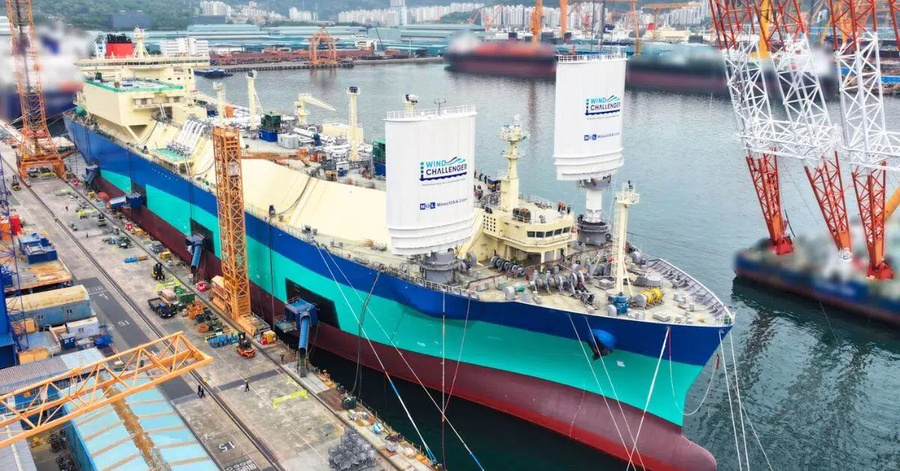
Mitsui O.S.K. Lines is preparing to put a 174,000 m³ LNG carrier into service with two Wind Challenger rigid sails, in what will be the world’s first application of a wind-assisted propulsion system (WAPS) on an LNG carrier.
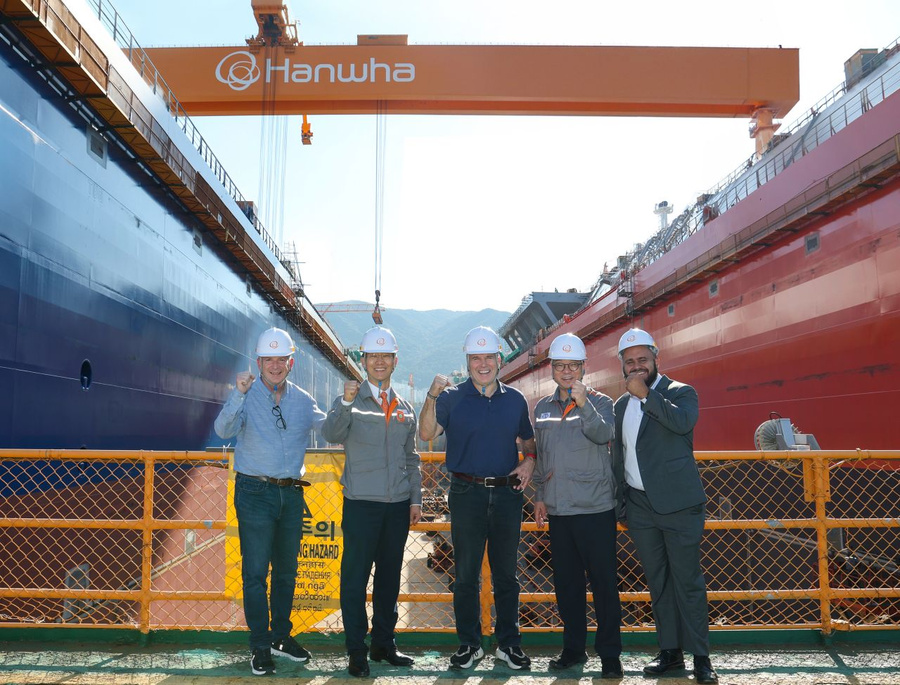
The vessel is scheduled for completion at Hanwha Ocean’s Geoje shipyard in South Korea at the end of September. Mitsui O.S.K. Lines presented the ship to the media at the yard on 7 September.
The LNG carrier will be managed by MOL Global Ship Management, a wholly owned subsidiary of Mitsui O.S.K. Lines. Following delivery, the vessel will transport LNG under a long-term contract with Chevron.
Wind Challenger uses rigid sails to harness wind as supplementary propulsion. The technology was commercialised by Mitsui O.S.K. Lines with Oshima Shipbuilding, based on joint industry-academic research led by the University of Tokyo.
High-precision sensors detect wind direction and speed, while the height and orientation of the sails are adjusted automatically. The telescopic units use lightweight fibre-reinforced plastic and can be set at three different heights.
Each Wind Challenger installed on the LNG carrier can extend to about 49 m and is approximately 15 m wide. The vessel will also be the first ship fitted with two Wind Challenger units.
Mitsui O.S.K. Lines expects the system to reduce annual average fuel consumption by 6-7%. For a single voyage on the Atlantic route between the US Gulf and Europe, the average reduction could reach up to 12%.
Weather routing will also be combined with the wind propulsion system, with further fuel savings expected from voyage optimisation.
Wind Challenger has already been installed as a single unit on each of two 90,000-100,000 dwt coal carriers and one 64,000 dwt Ultramax bulk carrier. The equipment has been operated commercially on those vessels.
Applying the technology to an LNG carrier required several design changes. The sails could not be installed close to tanks carrying hazardous cargo, while insufficient separation between the two units would limit their propulsion effect.
The final arrangement places the sails outside hazardous areas while maintaining sufficient distance between them. As the decision to install Wind Challenger was taken after the LNG carrier contract had been concluded, modifications were also made to the hull structure.
Bridge visibility requirements were reviewed with the shipyard, classification society and flag state. The resulting layout meets the applicable requirements. A fully enclosed bridge and an AI-based forward monitoring camera were also adopted to reduce the effect of visibility obstruction caused by the sails.
A second 174,000 m³ LNG carrier with two Wind Challenger units is scheduled for completion at Hanwha Ocean before the end of the year. The vessel will be built for Tokyo Gas.
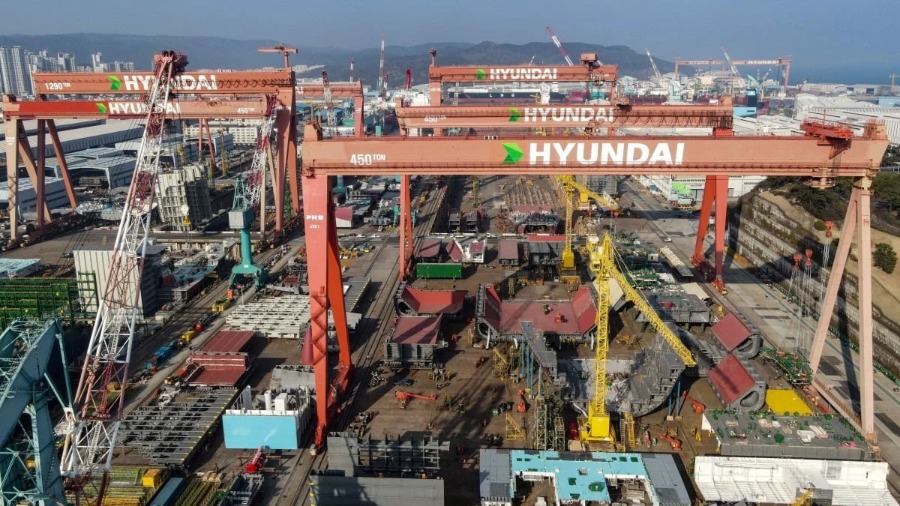
Mitsui O.S.K. Lines is also considering LNG carrier designs equipped with four Wind Challenger units. New vessel concepts are being jointly developed with HD Hyundai Heavy Industries and Samsung Heavy Industries, with fuel consumption reductions of up to about 30% per voyage and an annual average of 15-20% expected.
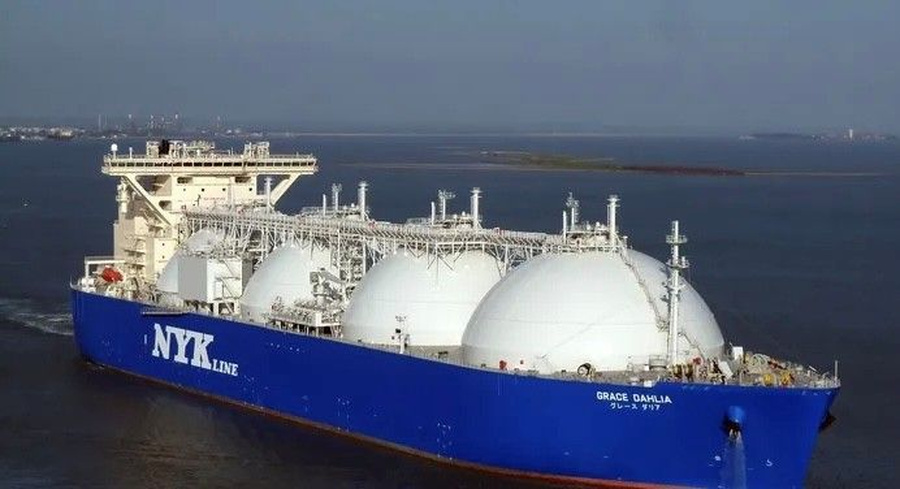
The LNG carrier fleet involving Mitsui O.S.K. Lines comprises 104 vessels, with another 22 newbuilds on order.