VARD, a subsidiary of the Fincantieri Group, has secured a contract worth more than €220 million to design and build two multi-function buoy and lighthouse maintenance vessels for Trinity House.
The vessels will replace THV Patricia and THV Galatea under Trinity House’s programme to renew its three-vessel fleet. Delivery is scheduled for the second and fourth quarters of 2029 from one of VARD’s yards in Norway.
The contract was awarded through a competitive public tender and is VARD’s first order for vessels of this type. It also includes a commitment to use British suppliers during the construction programme.
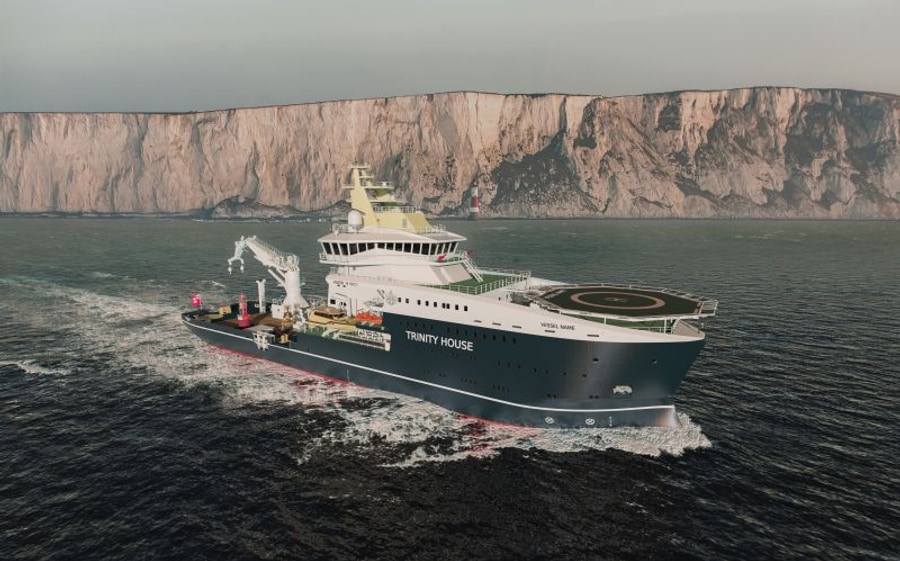
The newbuildings will be based on the VARD 9 601 design, developed by Vard Marine in Canada in collaboration with Vard Design in Norway.
Trinity House is the General Lighthouse Authority for England, Wales, the Channel Islands and Gibraltar. It maintains marine aids to navigation and also provides education, welfare and support to the seafaring community through its maritime charity activities.
The vessels will carry out buoy handling, hydrographic surveys and emergency responses to navigation hazards. Their main decks will be arranged for buoy handling and storage and fitted with a 30 t twin-hoist tension-control crane and two smaller stores cranes.
Each vessel will also have two workboats, a towing winch and a helideck. The design includes advanced dynamic positioning capability, a shallow-draft hull, stern azimuth propulsors, a tunnel thruster and a pump jet.
A hybrid propulsion system will allow the vessels to operate on battery power while alongside, at anchor and for limited periods during dynamic positioning and transit. The SeaQ energy storage system will have a capacity exceeding 3,600 kWh.
The battery system will provide peak shaving and spinning reserve support for the main generators. The vessels will also be designed for possible conversion to methanol fuel during their operational lives.
Vard Electro will supply the SeaQ power, control, bridge and communication systems and act as the project’s single system integrator. Its scope includes SeaQ DC switchboards, energy storage, shore connection equipment and the SeaQ Green Pilot energy management platform.
At quay, the shore connection and battery systems will allow the vessels to operate without emissions. SeaQ Green Pilot will collect and analyse data covering fuel consumption, emissions and vessel performance.
Cybersecurity will be integrated into the vessels through separation between operational and information technology systems, controlled interfaces and protected ship-to-shore data flows.
Vard Interiors will provide the complete interior package, including accommodation and HVAC-R systems. The vessels are designed to meet Maritime Labour Convention 2006 requirements and Lloyd’s Register CAC(1) and ABN(Q) class notations for noise, vibration and airborne noise.
The contract also includes an exchange programme under which apprentices will receive maritime training through cooperation between VARD, Trinity House and Vard Marine in Canada.