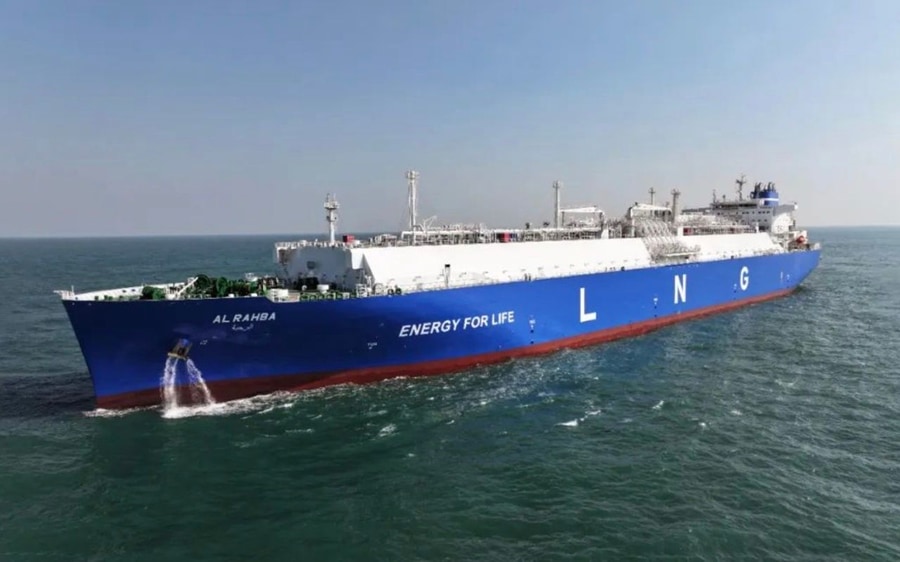
China State Shipbuilding Corp has started construction of the first QC-Max LNG carrier at Hudong-Zhonghua Shipbuilding in Shanghai, moving forward with a record LNG carrier program for QatarEnergy.
The vessel is the first in the QC-Max class and has not yet been named. It forms part of QatarEnergy’s order for 24 ultra-large LNG carriers. CSSC secured 18 ships in April 2024 and added six more later. The combined value exceeds 56 billion yuan, or $8.3 billion, making it the largest shipbuilding order on record.
Each QC-Max carrier is designed with a length of 344 m, a beam of 53.6 m and a 12 m draft. The ships will carry 271,000 cubic meters of LNG. CSSC said one vessel can transport enough natural gas to cover one month of demand for 4.7 million households in Shanghai.
Hudong-Zhonghua Shipbuilding described the project as a marker of China’s progress in high-value LNG carrier construction. The shipyard said the design combines large cargo capacity with lower energy use, reduced carbon emissions, environmental performance and high safety standards.
Compared with widely used 174,000-cubic-meter LNG carriers, the QC-Max design has 57% more cargo capacity. Its energy consumption is also 2% to 8% lower than rival designs from foreign shipbuilders, according to the shipyard.
LNG carriers transport cargo at -163 C, requiring advanced insulation and specialist materials. Hudong-Zhonghua Shipbuilding said each vessel uses special Invar steel and contains more than 130 km of Invar weld seams.
The shipyard began its LNG carrier development program in 1997 and won its first order in 2004. China’s first domestically built LNG carrier, Dapeng Sun, was completed and delivered at the Shanghai yard in 2008.
To date, Hudong-Zhonghua Shipbuilding has built and delivered 62 LNG carriers. In 2025, it completed 13 large LNG carriers and delivered 11. Its current LNG carrier orderbook stands at 92 vessels, with deliveries scheduled through 2031. The shipyard plans to raise annual output to more than 20 LNG carriers by the end of China’s 15th Five-Year Plan period from 2026 to 2030.