China’s advance in the LNG carrier (LNGC) market is accelerating as a tightly coordinated model linking finance, energy demand and shipbuilding gains traction, heightening concern that global ordering dynamics could face sustained pressure.
Chinese shipbuilders secured orders for 13 LNGCs in January alone, exceeding the combined total booked by Korea’s three major builders—HD Korea Shipbuilding & Offshore Engineering, Samsung Heavy Industries, and Hanwha Ocean—during the same period and already surpassing China’s full-year LNGC orders from the previous year.
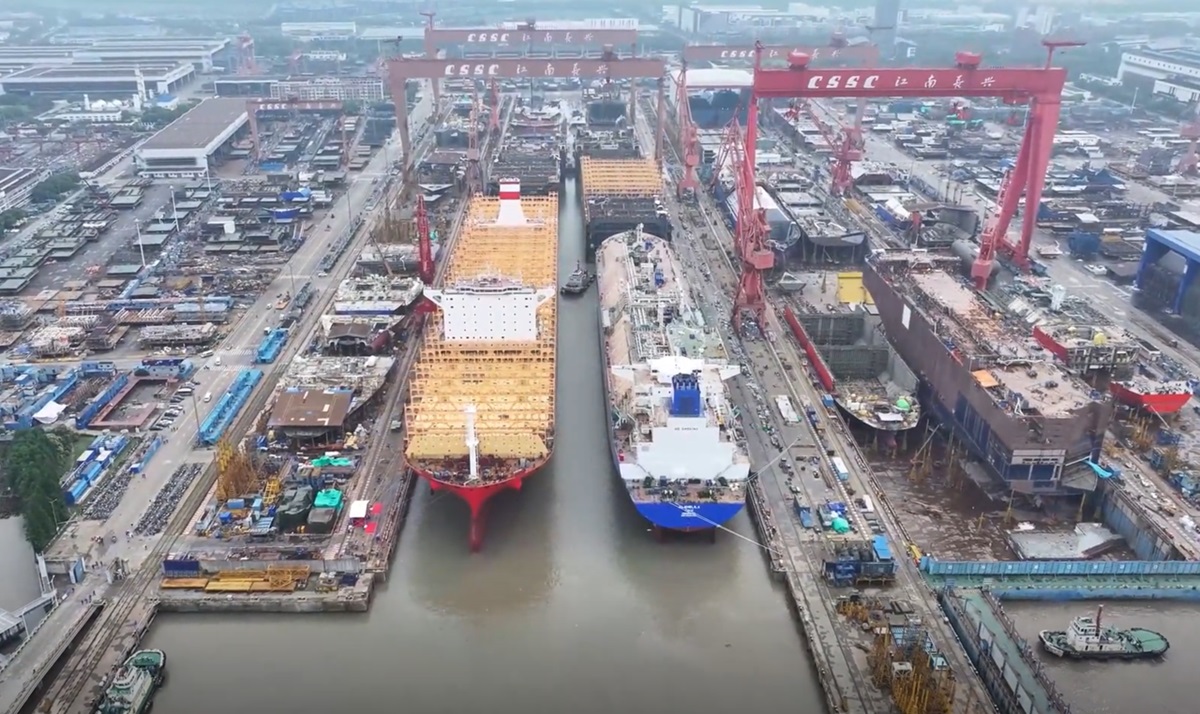
Industry sources said a notable transaction took place late last month, when state-owned carrier Shandong Marine ordered four 175,000-tonnes LNGCs from Jiangnan Shipyard. While Shandong Marine placed the order, ownership is structured through Minsheng Financial Leasing, a subsidiary of China Minsheng Bank, which provides the financing. Shandong Marine is responsible for vessel management and operations.
The four LNGCs are scheduled to enter long-term charter with Shell upon delivery, securing employment and revenue from the outset and reducing post-delivery operational exposure, a long-standing challenge for the shipbuilding sector.
Market participants view this structure—combining state-backed financial support, national shipping capacity and demand from a global energy major—as a growing counterweight to the technology- and productivity-driven approach traditionally adopted by Korean yards. The contract price is reported at about $220 million per vessel, below the roughly $250 million level recently achieved by Korean builders for comparable LNGCs. Although the pricing is seen as influenced by close coordination among Chinese state-linked entities, continued low-price ordering could weigh on market conditions if replicated at scale.
This integrated LNGC ordering model has been taking shape since 2022. China’s LNGC order share, estimated at around 7% through 2021, rose sharply to about 30% from 2022, narrowing the gap with Korea. In 2024, Korea’s share declined to roughly 57%, while China reached a record level in the 40% range. Although China’s share fell back sharply last year, recent orders indicate renewed momentum.
Of the 13 LNGCs ordered in January, six were secured by Jiangnan Shipyard and seven by Hudong-Zhonghua Shipbuilding, according to industry data. Other Chinese yards capable of LNGC construction include CMHI, DSIC, Jiangsu Yixiang Shipbuilding, and Yangzijiang Shipbuilding, reinforcing expectations that policy-linked financing could distribute orders across multiple builders.
A Korean shipbuilding industry official said productivity remains the primary lever available, but added that overcoming China’s cost structure is difficult. With labour costs in China estimated at roughly one-third of Korean levels, the official noted that matching competitiveness would require productivity gains well beyond current technical gaps. The source added that Korea continues to benefit from customers prioritising delivery reliability and quality over cost, but cautioned that competitive pressure is likely to persist over the longer term.