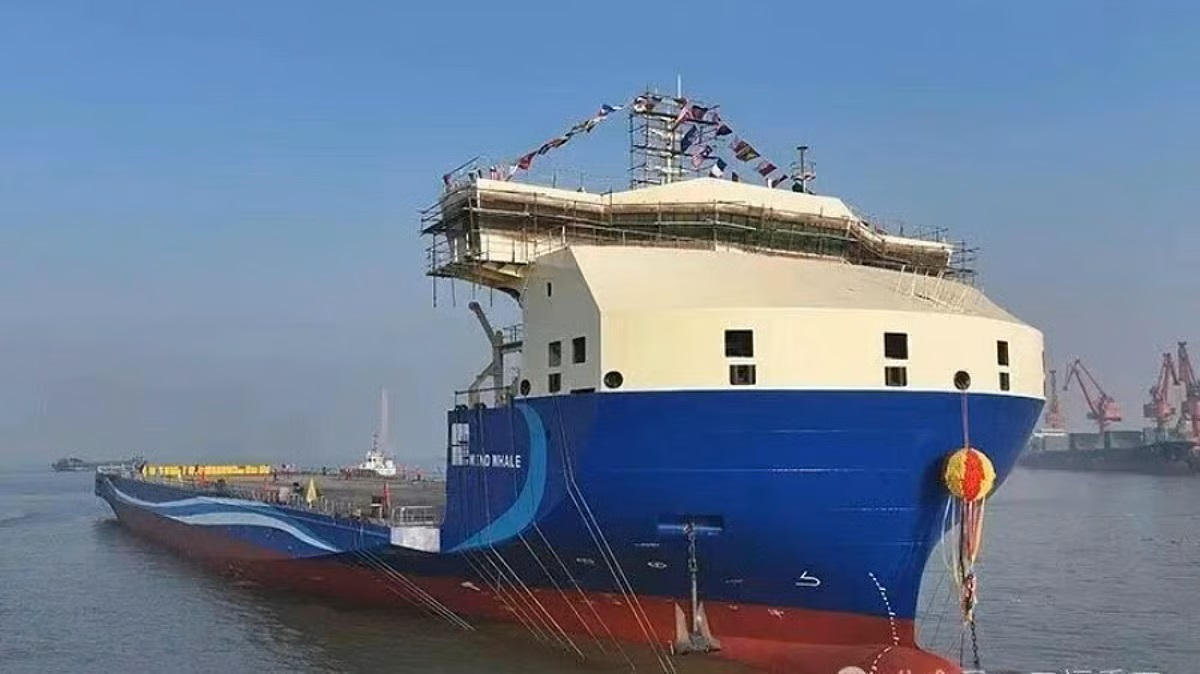
On 24 January, Sanfu Shipbuilding launched a new 13,000 DWT-class deck carrier for a Japanese owner from its No. 2 slipway. The vessel is tailored for offshore engineering projects in Japan and combines specialised cargo arrangements with redundant electric propulsion and an integrated DC power and battery system to support safe and efficient operations.
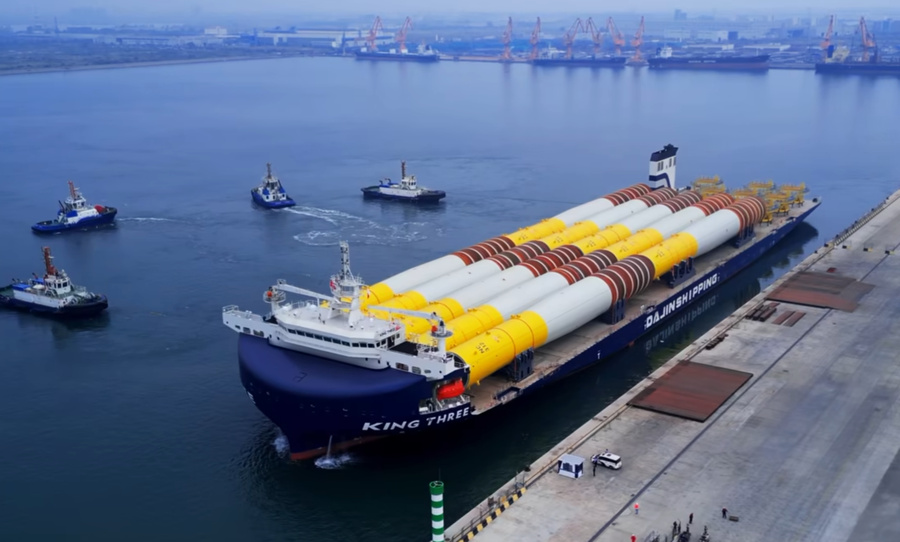
The ship is conceived as a dedicated deck carrier for offshore equipment, wind power components and port machinery. It incorporates a number of advanced features in the cargo deck, propulsion layout and electrical configuration to provide high loading flexibility, operational reliability and strong energy efficiency while serving varied project cargo requirements.
At the heart of the cargo concept is a wide, flush working deck fitted with folding railings along its perimeter. This arrangement creates an open, unobstructed cargo area. The deck is rated for a design load of 20 tonnes per square metre and accommodates multiple handling modes, including stern ramp ro-ro operations, which increases options for loading and discharging different types of project cargo.
The ballast system uses a compact tank arrangement combined with a centralized ventilation concept. Ventilation ducts are routed together to the aft wall of the superstructure so that individual vent pipes on deck are eliminated. This improves deck openness for cargo stowage and allows the vessel’s buoyancy condition to be adjusted quickly, helping to maintain stability during cargo operations and sea passages.
For propulsion control, the ship adopts a dual-redundant architecture. Two independent electric propulsion units act as mutual backups so that a failure of one unit does not remove basic manoeuvring capability. The twin bow thrusters are also equipped with redundant arrangements, supporting reliable vessel control even if one side becomes unavailable and enhancing safety during navigation and cargo handling.
The core power system is based on ABB DC variable-frequency technology. A DC bus is combined with a battery energy storage system to raise energy utilisation efficiency and improve the stability of the power supply. Four variable-frequency generator sets fitted with SCR denitration equipment are grouped in the forward engine room to meet stringent environmental requirements. The power plant is closely integrated with a route optimisation algorithm and an intelligent energy efficiency management platform, enabling efficient operation of the power system through intelligent control and providing support for both endurance and operating economy.
The 13,000 DWT series has been designed by Germany’s HEAVY LIFT Design Company and employs a forecastle arrangement. Principal particulars include an overall length of 149.9 m, a beam of 30.0 m, a depth of 8.7 m and a maximum deadweight of 13,000 tonnes. The vessel is designed for a speed of 12.9 knots and is classed by NK.