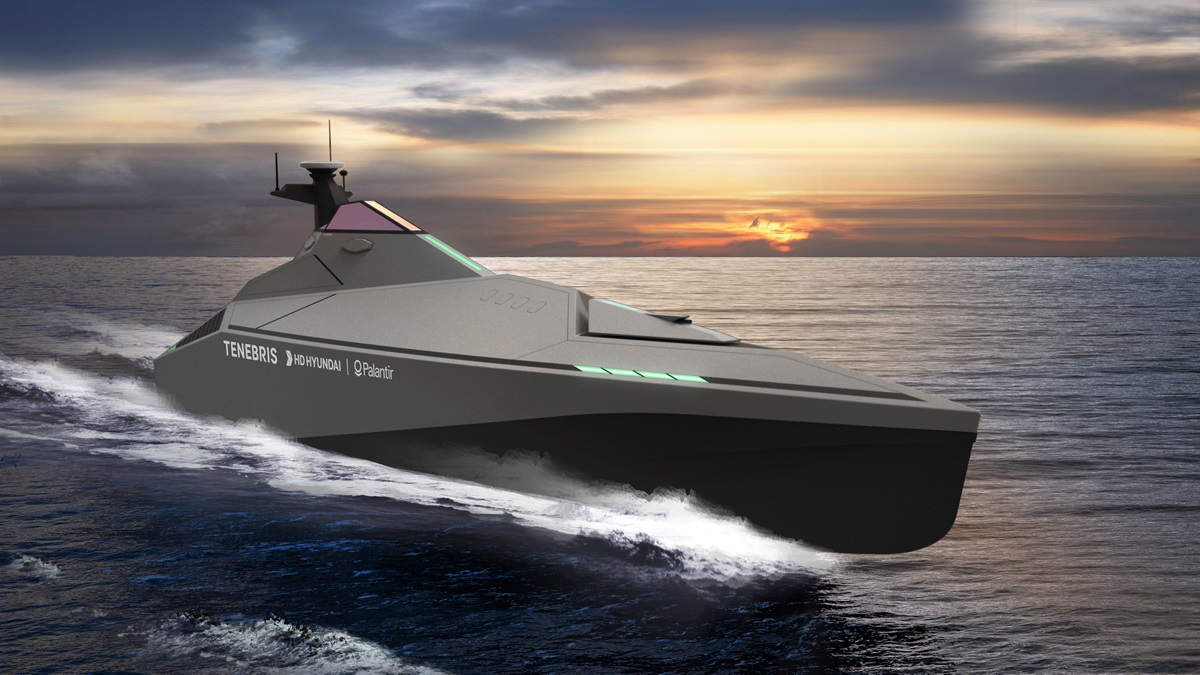
South Korea’s shipbuilding and defense sector has formed an uncommon “single-team” structure for a naval unmanned program, with HJ Shipbuilding & Construction joining LIG Nex1 and HD Hyundai Heavy Industries to pursue core technologies for combat unmanned surface vessels (USVs).
Rather than starting with a finished ship design, the consortium’s work centers on the “brain and nervous system” required to operate a combat USV: integrated control and autonomous mission functions that allow an unmanned craft to execute maritime tasks through remote operation or autonomous navigation. Combat USVs are generally viewed as a pathway to reduce personnel exposure while expanding surveillance, reconnaissance, and mission coverage at sea.
Under the project framework, HJ Shipbuilding & Construction has signed an agreement with the Agency for Defense Development (ADD) to act as designer and builder of a verification platform—effectively a large unmanned vessel intended to validate the integrated control and autonomous mission technologies developed under the program.
The core-technology effort is being advanced through a government-led structure that involves defense acquisition and research stakeholders, with the stated goal of securing capabilities required for the Navy’s Batch-II combat USV system development. The program is positioned as part of South Korea’s broader push toward manned–unmanned teaming at sea.
Workshare inside the consortium is split between platform and system integration. HD Hyundai Heavy Industries and HJ Shipbuilding & Construction are to design and construct the unmanned surface vessel platform used for verification. At the same time, LIG Nex1 is tasked with developing and validating the integrated control system, weapon control system, and autonomous mission system that link the platform to mission equipment.
The consortium had been preparing the proposal jointly and was selected as the preferred negotiation partner in August, before formalizing project arrangements disclosed on 23 December.