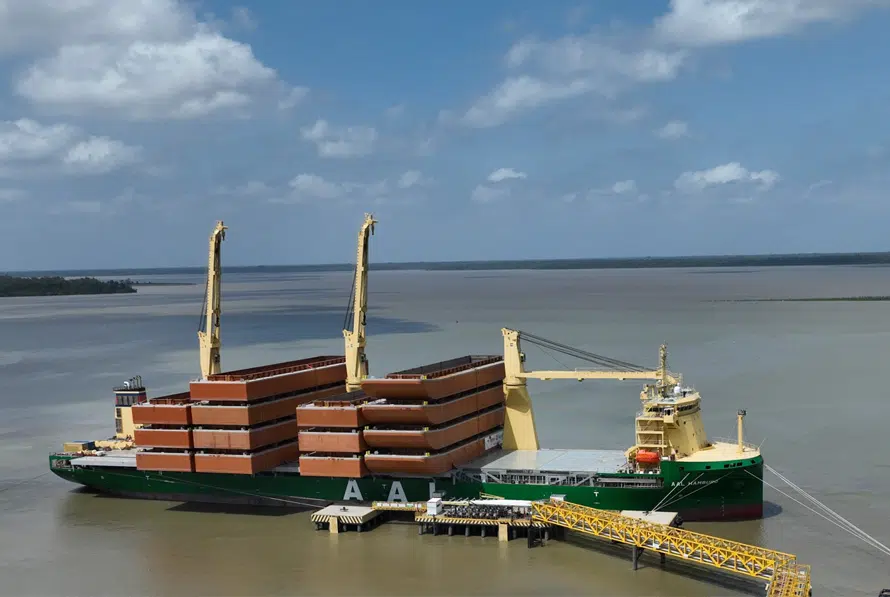
The 32,000 dwt heavy-lift vessel AAL HAMBURG has completed what AAL describes as one of its most complex engineering tasks so far, transporting 16 bulk-commodity transport barges on a single voyage from Brazil to Uruguay. The consignment totalled 80,000 freight tons and made full use of the capabilities of AAL’s 32,000 dwt Super B-Class together with its in-house engineering and operations teams, marking the first stage in establishing a regular presence in the South American market.
The barges delivered by AAL are destined for regional mining logistics, where they will be used to move iron ore and manganese ore from Brazil to Uruguay for export. Their introduction is expected to raise capacity for waterborne bulk movements using inland waterways and to support Brazil’s role in international commodity flows. The ores will travel more than 2,500 km along the Paraguay–Paraná Waterway, a key inland corridor linking Brazil, Bolivia, Paraguay, Argentina, and Uruguay with the Atlantic Ocean.
Each barge measures 61 m in length and 15 m in beam, with an individual weight between 380 t and 400 t. Loading and stowage took place over several days, during which the barges were arranged in a transverse four-tier stack with a 15 m overhang on both the port and starboard sides of AAL HAMBURG – a configuration that is rarely used in the multipurpose and project cargo sector. This set-up, supported by AAL’s ECO-DECK retractable deck-extension system, enabled the vessel to carry all 16 units in one sailing, with 14 barges on deck and two in the hold, a volume previously not achievable with other vessel types or conventional multipurpose cargo arrangements.
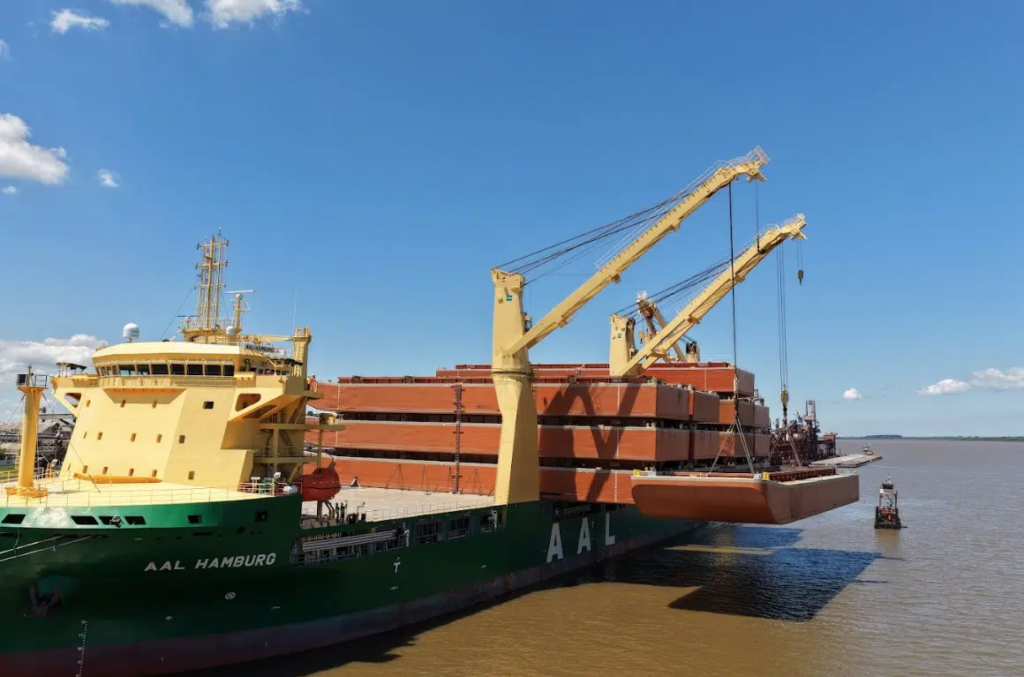
The substantial overhang on each side of the ship created significant stability challenges on the 3,400 km ocean passage from northern Brazil to Uruguay. According to AAL, its engineering team spent several weeks developing a safe and efficient transport solution that met the client’s requirements, based on detailed planning and cooperation with partners across the supply chain. Throughout the operation, AAL HAMBURG worked as a self-sustaining vessel, using her own 700 t maximum-lift cranes instead of relying on floating cranes that are costly and difficult to source, and in this way supporting operational efficiency and safety during loading and discharge.
Eugene Nutovych, Senior Chartering Manager, AAL Americas, said the project has extended the company’s experience with large-scale barge shipments and generated useful operational insights for AAL and other stakeholders involved, which will be relevant for future project demands. He added that production of high-grade iron and manganese ore is commercially important for the region, contributing to the local economy and employment, and that the new barges will both increase transport capacity and promote a shift from road movements to a cleaner and more efficient waterway-based transport solution.