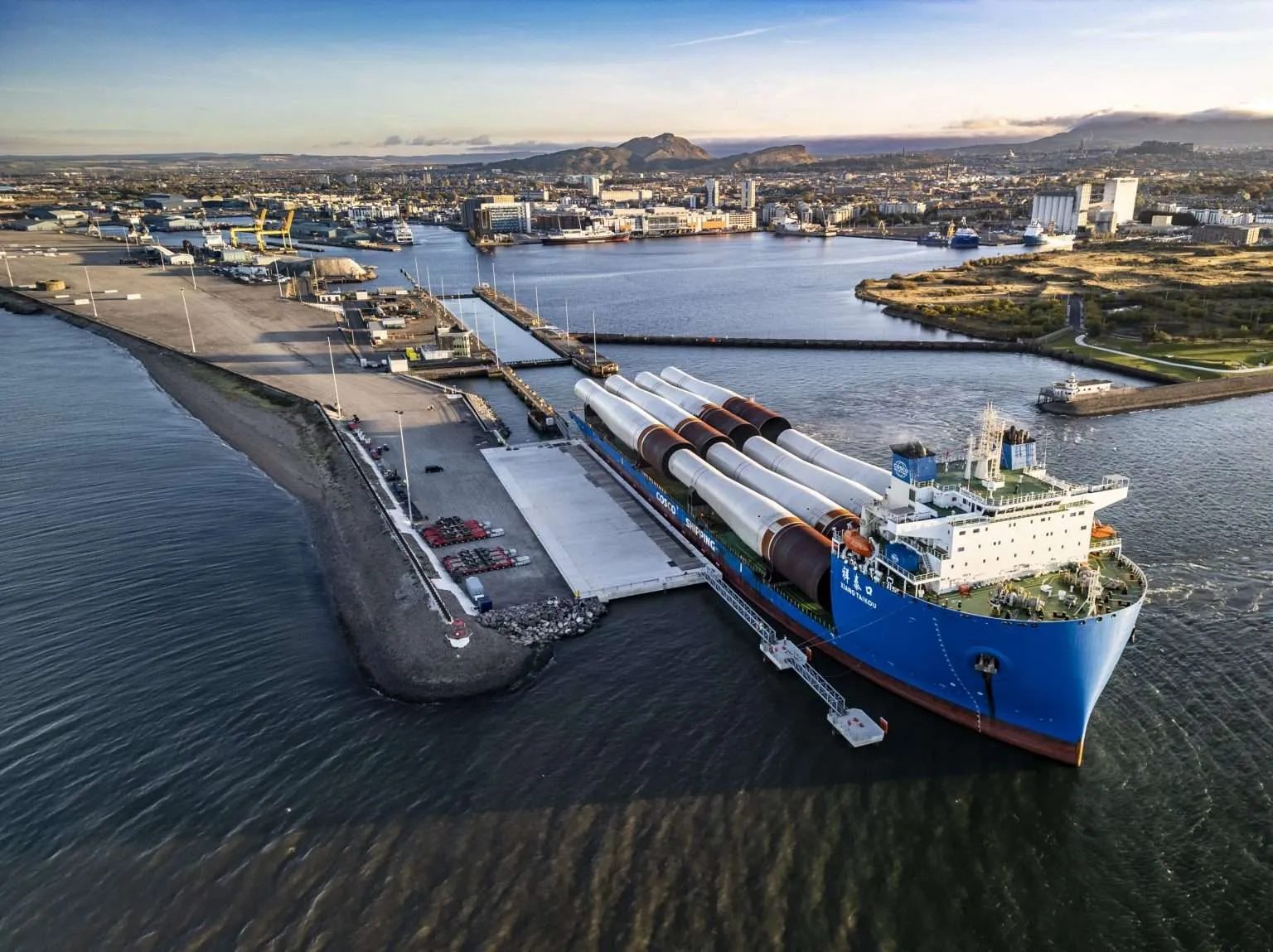
The first eight XXL monopiles for the Inch Cape Offshore Wind Farm have arrived at the Port of Leith, marking a major milestone for one of Scotland’s largest offshore renewable energy projects and a new operational phase for Forth Ports’ newly completed renewables hub.
Transported aboard a heavy transport vessel to the recently opened Charles Hammond Berth, the XXL monopiles — each up to 103 meters long, weighing about 2,300 tonnes, and measuring 11.5 meters in diameter — were produced by CWHI. The arrival kicks off an intensive phase of offshore foundation construction for the 1.1GW project, located approximately 15 km off the Angus coast in the North Sea.
The £150 million redevelopment of the 175-acre Port of Leith site, including £50 million invested to support Inch Cape, has transformed the facility into one of Europe’s most capable offshore wind logistics and marshalling centers. The Charles Hammond Berth is capable of handling loads up to 100 tonnes per square meter and accommodating the world’s largest offshore installation vessels.
John Hill, Project Director at Inch Cape, commented, “This first monopile delivery into Leith kicks off a key phase of offshore construction, and we are delighted to be the inaugural project to utilise Forth Ports’ renewables hub. Monopile supplier CWHI has done an outstanding job, fabricating the monopiles on time, within budget and with more than a million hours of safe work.”
The Inch Cape Offshore Wind Farm will ultimately include 54 XXL monopiles, 54 transition pieces, and 18 three-legged jacket foundations. Installation is set to begin by the end of 2025 using Jan De Nul’s heavy lift vessel Les Alizés and will continue through 2026.
Once complete, Inch Cape will feature 72 Vestas 15MW turbines and a single offshore substation, delivering nearly five terawatt-hours of clean electricity annually — enough to power half the homes in Scotland. The project is being developed as a 50:50 joint venture between Red Rock Power Ltd. (UK) and ESB (Ireland), with first power expected in late 2026 and full commercial operation in 2027.