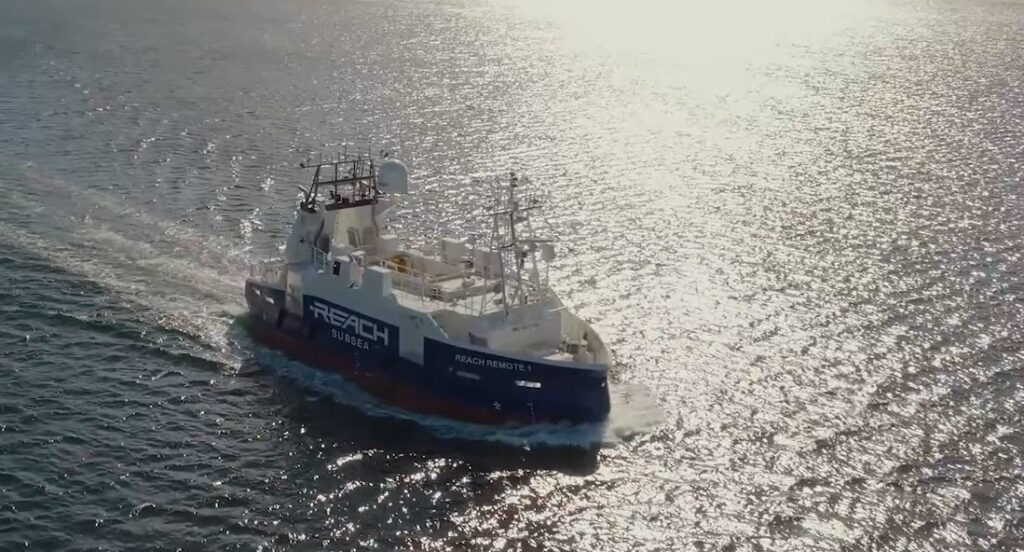
Haugesund, Norway — October 13, 2025. Reach Subsea has announced that its uncrewed surface vessel (USV), Reach Remote 1, has received official clearance from the Norwegian Maritime Authorities to conduct full operations without a supporting vessel. The approval followed a verification and evaluation process in cooperation with DNV.
Reach Remote 1, already in commercial service, has now completed the final validation phase enabling fully autonomous and remotely operated offshore missions. This marks the first time a USV of this class—equipped with a work-class remotely operated vehicle (ROV)—has been authorized to operate independently without manned assistance.
The certification process included a series of supervised operations earlier this year, during which Reach Remote 1 was operated with a crewed support vessel nearby. These trials demonstrated consistent safety performance and reliable control across multiple offshore scenarios. Following those tests, DNV and the maritime authorities confirmed that the vessel’s safety systems and situational awareness capabilities meet or exceed the standards required for traditional crewed vessels.
On October 11, Reach Remote 1 departed for the Ormen Lange gas field to begin its first operational campaign conducted entirely without a supporting vessel. The mission represents a key step toward autonomous and low-emission offshore operations.
Reach Remote 1 is part of a broader development program aimed at reducing emissions and minimizing personnel exposure at sea. The company is preparing Reach Remote 2 for deployment in Australia, while Reach Remote 3 and Reach Remote 4 are currently under construction. Together, these platforms form the foundation of a new generation of remotely operated subsea and surface assets designed to transform offshore inspection and maintenance operations.
The authorization demonstrates tangible progress in integrating autonomous maritime technologies into commercial operations. It also reflects a broader industry trend toward cost-efficient, low-risk, and sustainable offshore service models.