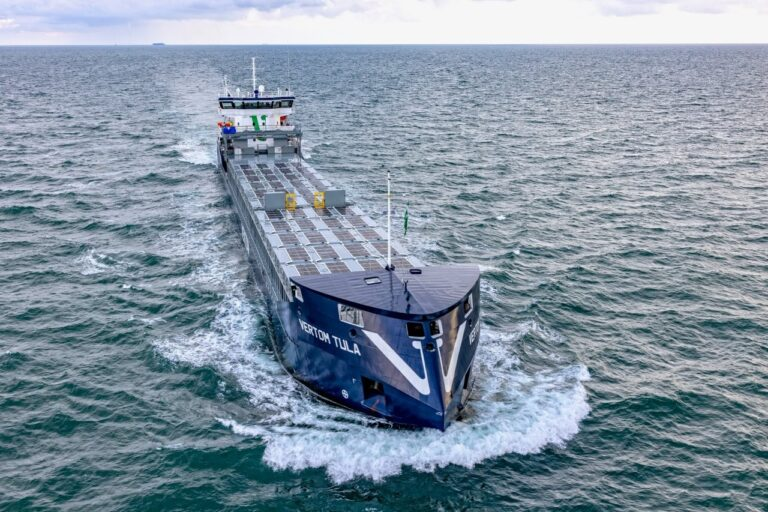
Rotterdam, the Netherlands – Dutch maritime solar innovator Wattlab has completed its first full-scale Solar Flatrack installation on the 7,280 dwt diesel-electric multipurpose cargo vessel MV Vertom Tula, owned by shortsea shipping company Vertom. This project marks the world’s first solar energy system installed on a seagoing ship, representing a significant technical milestone for sustainable shipping.
After two successful pilot projects conducted over the past three years, Vertom decided to equip its newest vessel with 79 kWp of installed solar capacity—the first of its kind at sea. The 44 Solar Flatracks installed onboard will power vessel systems and reduce around 20% of the hotel load.
The panels were produced and assembled in September at Wattlab’s new production facility in Rotterdam, and subsequently installed within one day at the Port of Harlingen. The Solar Flatracks use standard container twist-lock fittings, allowing rapid installation and removal. If necessary, the panels can be stacked and stored on the footprint of a single 20ft container, preserving valuable deck space for special cargoes.
Bo Salet, Co-founder and CEO of Wattlab, said:
“For shipowners, time is money, so speed and ease of use are important. Furthermore, we know that ‘space is money’ too. Hence, should the panels need to be removed to make way for a special type of cargo, the crew can easily stack and store them all on the footprint of one 20ft container. We thank Vertom for their trust and the smooth collaboration in the past three years. Without them we could not have achieved this milestone; that goes both for the vessel itself as for the technology. We wish the Vertom Tula and its crew fair winds and following seas! In addition, we thank the EU’s Just Transition Fund (JTF), which co-financed this project.”
Thomas van Meerkerk, Business Development Manager at Vertom, commented:
“During the pilots, the test results showed that the Solar Flatrack system performs well in the tough coastal shipping environment. Based on the results of our own and TNO’s research in the past months, we consider Wattlab’s Solar Flatrack an effective option for reducing GHG and pollutant emissions. Of course, these things also depend on the conditions our vessels operate in, but it’s clear that the system can provide both a positive ROI and contribute to CO₂ reduction in shipping.”
The Dutch independent research organization TNO has validated both the CO₂ reduction potential and ROI timeframe of the Solar Flatrack system, with its report to be published shortly.
The project received financial support from the European Union’s Just Transition Fund (JTF)—a key instrument of the European Green Deal’s Just Transition Mechanism, which aims for EU-wide climate neutrality by 2050.
Vertom, which operates a fleet of over 100 vessels ranging from 1,500 to 12,000 dwt, provides a wide range of maritime services including Shipping & Trading, Port Agencies & Freight Forwarding, Maritime Services, Tanker Chartering, and Liner Services. The company maintains a strong presence in the Short Sea Shipping market and aims to operate sustainably.
Having a first operational Solar Flatrack system on a coaster represents a significant step in the evolution of maritime decarbonization strategies. With increasing regulatory pressure from FuelEU Maritime and the EU Emissions Trading System (ETS), shipowners are seeking practical solutions to diversify their onboard energy sources. Wattlab’s scalable solar solution now offers a proven pathway toward emission reduction, fuel savings, and onboard energy resilience—without compromising cargo flexibility or deck space.