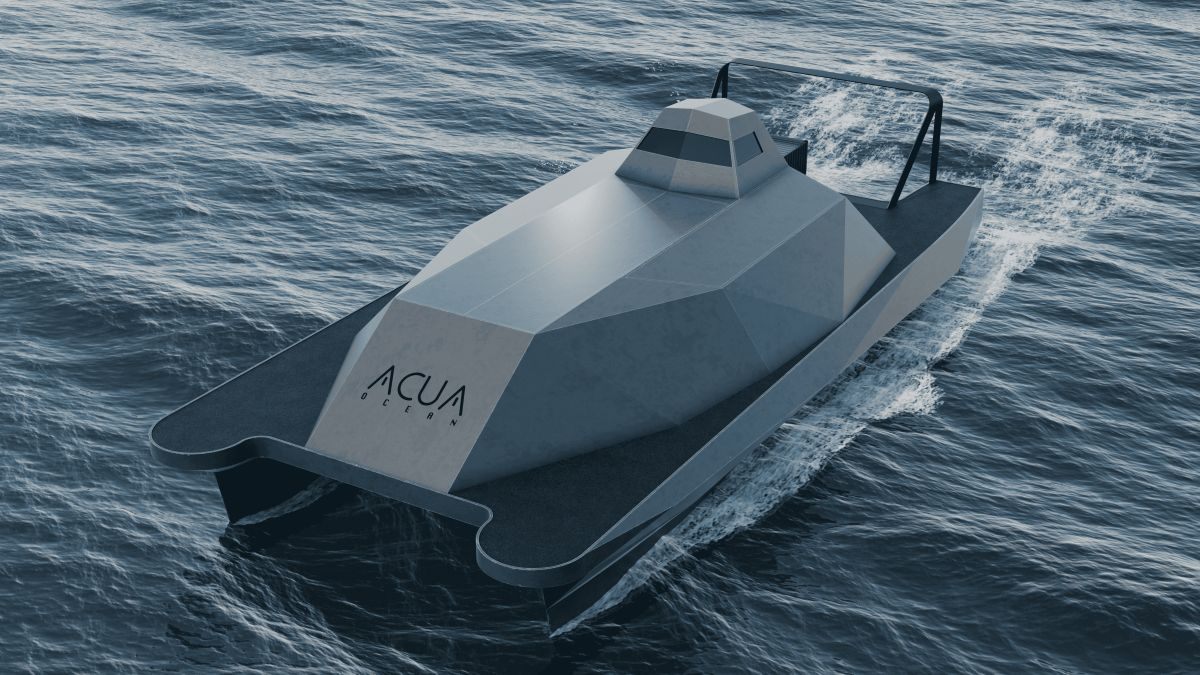
A UK consortium led by ACUA Ocean is developing a new 145 ft (43 m) medium-sized uncrewed offshore support vessel after securing funding from the Department for Transport’s CMDC programme. Project MROS brings together Houlder, Ad Hoc Marine Designs, Trident Marine Electrical and the University of Southampton to deliver the design and validation of the vessel.
The consortium received CMDC funding in May 2025. Since then, the partners have advanced the design of the MROS vessel and moved into hydrodynamic testing. Resistance and seakeeping trials are being carried out at the Southampton Marine & Maritime Institute and the Wolfson Unit to verify performance in a range of sea conditions.
The 43 m platform uses a hybrid electric power arrangement and is intended to operate in uncrewed autonomous or remote modes, as well as with a small embarked crew when required. Current prototype work is focused on methanol as a fuel option and compares this with hydrogen, ammonia and diesel variants on efficiency, performance, maintainability and emissions.
The new vessel builds on experience from the 46 ft (14 m) USV Pioneer. That design uses a SWATH (small-waterplane twin-hull) configuration to reduce motions and improve stability in higher sea states, and the same general approach is being scaled for MROS. The project follows around four months after USV Pioneer became the first uncrewed surface vessel to obtain UK Maritime and Coastguard Agency Workboat Code 3 approval, giving the team a certified reference platform.
Operationally, the MROS vessel is planned for autonomous or remote control, with the option to embark a small team in a modular accommodation unit. It is being specified for operation in Sea State 6 and above, with DP1-class station-keeping, a range of about 2,500 nm, endurance of more than 20 days and a sprint speed above 20 knots.
The uncrewed support vessel is intended for tasks that require long-duration and robust offshore presence, including offshore logistics, maritime surveillance, subsea inspection and intervention, and support to commissioning and decommissioning of offshore infrastructure. The design provides for an 80 tonnes payload so that cargo, containerised equipment or specialist sensor packages can be embarked.
A central moonpool is incorporated to support underwater operations. Space is reserved for twin launch-and-recovery systems able to deploy and recover different types of subsea vehicles, including tethered and untethered ROVs and extra-large uncrewed underwater vehicles (XUUVs).
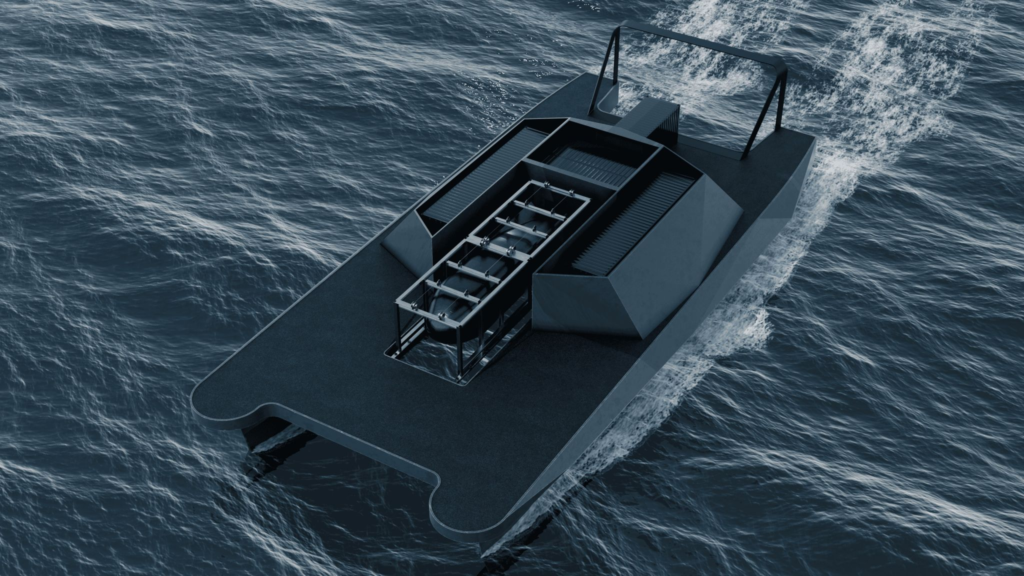
As with USV Pioneer, the cargo and payload spaces on MROS are arranged to accept ISO-standard container footprints in both TEU and FEU sizes. This approach is intended to simplify mechanical installation and removal of mission equipment, support interchangeability of payloads and ease logistics and maintenance planning.
ACUA Ocean plans to add further technology partners as the project progresses, with the aim of establishing a set of integrated mission payloads that can be used on both USV Pioneer and MROS. These payloads are being developed to reflect current operational requirements from end users while enabling common equipment across the two platforms.
Neil Tinmouth, CEO of ACUA Ocean, said the MROS project extends the company’s work in delivering certified uncrewed vessels and that the design is being developed to provide significant capability and cost benefits compared with other uncrewed systems under development.
John Kecsmar, Director at Ad Hoc Marine Designs, noted that his firm designed USV Pioneer and that the larger MROS platform is expected to apply the same design principles at a greater scale to improve offshore operability.
Rupert Hare, CEO of Houlder, said the company is continuing its cooperation with ACUA Ocean on Project MROS after contributing to USV Pioneer. Houlder is leading the concept design for launch-and-recovery systems for subsea payloads such as ROVs and XUUVs, and is also working on hull optimisation and integration of alternative fuel arrangements.
Lee Sidaway, Director of Trident Marine Electrical, said the company is responsible for the electrical design of the 43 m partially crewed vessel, continuing its collaboration with ACUA Ocean from USV Pioneer and focusing on reliable integration of autonomous and hybrid marine systems.
Professor Stephen Turnock of the University of Southampton said future maritime operations at this scale will require minimally crewed ships using cleaner fuels, and that the university is contributing its expertise in fuels, autonomous systems and naval architecture to the MROS project.