A Reuters investigation has documented how China is using civilian cargo ships and ferries as part of exercises related to potential amphibious operations against Taiwan. Based on the agency’s review of vessel-tracking records and satellite imagery from mid-August, the drills showed China testing methods intended to move troops and vehicles onto multiple landing points.
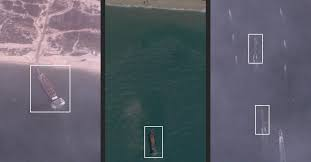
According to Reuters, 12 civilian ships—a mix of six roll-on/roll-off ferries and six deck cargo vessels—sailed to a coastal area near Jiesheng in Guangdong Province during the summer exercise. Images captured on 23 August showed several vessels deploying ramps directly onto the shoreline to unload vehicles. These ships, about 90 m long and widely used in Asian coastal shipping, can reach beaches without port support due to their shallow draft and open deck design.
The investigation also observed the use of a self-propelled floating pier system, last seen in 2023, indicating continued development of temporary infrastructure for rapid unloading if Taiwan’s port access were disrupted. Reuters reported that Washington’s response would remain central: President Joe Biden has previously stated that U.S. forces would defend Taiwan if an attack occurred, while a White House spokesperson said U.S. policy is to maintain Taiwan’s defensive capability and asserted that China would not launch an attack during President Donald Trump’s term.
Beijing stated that the Taiwan issue is an internal matter and repeated that peaceful “reunification” is preferred, though it will not allow separation “by any means.” China’s defense ministry did not comment.
Taiwan pointed Reuters to earlier remarks by Defense Minister Wellington Koo, who said the island maintains continuous oversight of China’s use of roll-on/roll-off ships and has established contingency plans.
Reuters cited Admiral Lee Hsi-min, former chief of Taiwan’s armed forces, who said the imagery shows China preparing for “multi-point, small amphibious landing operations,” using numerous smaller craft rather than concentrating forces at a few entry sites. The report noted that China’s military fleet can transport roughly 20,000 troops, far below the 300,000 to 1 million personnel experts estimate would be necessary for an invasion, making civilian vessels a significant expansion of lift capacity.
During the August drill, at least 330 vehicles were observed on or near the beach. Over the past year, Reuters tracked more than 100 civilian vessels associated with drills, working with BlackSky Technology to collect satellite observations.
Experts interviewed by Reuters highlighted China’s dominance in shipbuilding—53% of global output compared with 0.1% for the United States—and noted that Chinese law allows the People’s Liberation Army to requisition civilian ships, giving Beijing greater transport capability than its military fleet alone provides.
Taiwanese officials offered differing views. Yuster Yu, a retired naval officer, said the findings highlight concrete preparations for an invasion. Another senior defense official, speaking anonymously, questioned the survivability of civilian vessels in combat and suggested the drills may form part of China’s cognitive warfare strategy aimed at affecting morale in Taiwan and among allies.
Source: Reuters