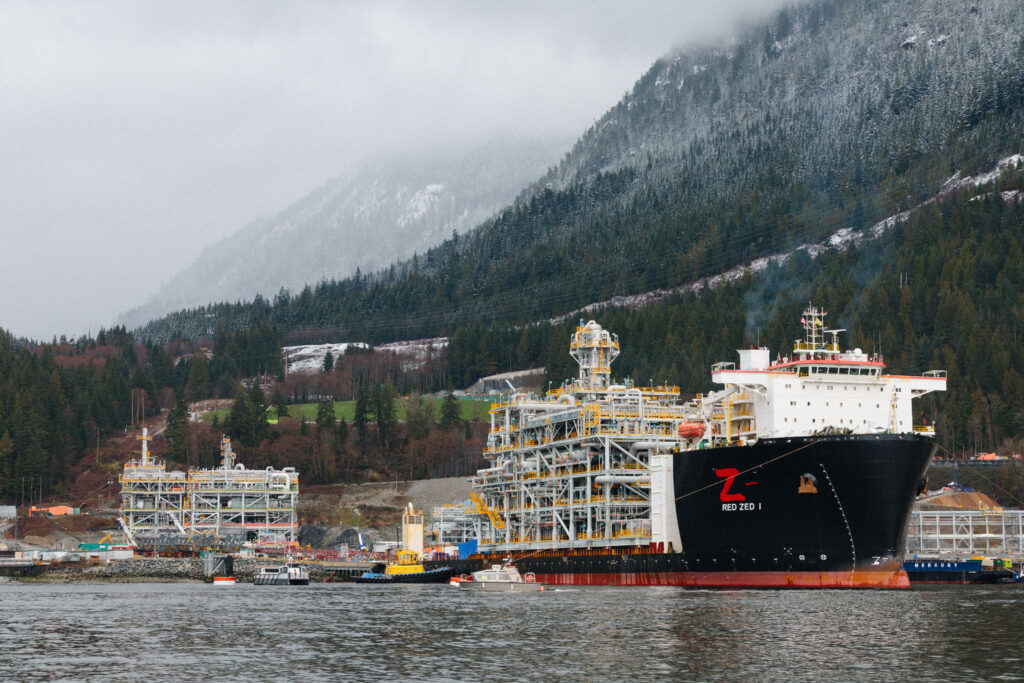
The semi-submersible heavy load carrier Red Zed 1 reached the Woodfibre LNG project site on 10 March 2026 with the liquefaction module onboard, adding to ongoing construction activity near Squamish on Squamish Nation territory.
Woodfibre LNG said the liquefaction module arrived at the site aboard the specialized heavy cargo vessel on the afternoon of 10 March. The unit is the 15th module to arrive as the project moves closer to construction completion.
Weighing 10,847 tonnes, the liquefaction module is the heaviest module for the future Woodfibre LNG facility. It occupies a footprint roughly the size of a football field and is also among the largest modules for the project.
“The liquefaction module is the beating heart of our facility. It’s the core of how we will transform B.C. natural gas into LNG to be shipped around the world,” said Luke Schauerte, CEO of Woodfibre LNG. “As the world’s first LNG export facility using renewable power for electric-drive liquefaction, this module represents the core of our commitment to net-zero operations and setting a new standard for LNG, both in Canada and around the world.”
The liquefaction module is the central component of the LNG production process. Once installed and commissioned, it will cool natural gas to approximately -162°C, turning it into an energy-dense liquid for overseas shipment.
A key element of the project’s liquefaction design is the use of Siemens electric-drive motors. In conventional LNG facilities, the liquefaction process is typically driven by gas turbines operating off feed gas, creating significant greenhouse gas emissions. By using electric-drive technology connected to BC Hydro’s renewable power grid, Woodfibre LNG eliminates the single largest operational source of greenhouse gas emissions in LNG facilities. The company said electric-drive systems also offer advantages in overall efficiency and lower maintenance needs.
“Woodfibre LNG is showing the world what’s possible in responsible LNG development, including being the first project of its kind to be regulated by an Indigenous government. By producing among the world’s lowest emission LNG, Woodfibre LNG is proof-positive that LNG produced off Canada’s west coast is the world’s most sustainable product offering, and that Canada is well positioned to supply export markets around the world,” Schauerte said.
All 19 modules for the Woodfibre LNG facility are expected to be on site this spring. Construction is scheduled to be completed in 2027.
The project is being built near Squamish on the traditional territory of the Sḵwx̱wú7mesh Úxwumixw (Squamish Nation). It is designed to produce 2.1 million tonnes of LNG for export annually.
Woodfibre LNG Limited Partnership owns the project. The partnership is owned 70 per cent by Pacific Energy Corporation (Canada) Limited and 30 per cent by Enbridge Inc.
The company said Woodfibre LNG is the first industrial project in Canada to recognize a non-treaty Indigenous government, Squamish Nation, as a full environmental regulator. It also said the facility will be the world’s first net zero LNG facility when completed in 2027.