On 1 January 2026, Qingdao Port, part of Shandong Port Group, placed the country’s first automatic mooring system using vacuum technology into commercial service at the Qingdao Automated Container Terminal, marking another step in berth-side automation across China’s increasingly digitalised port sector.
Working alongside the terminal’s automated quay cranes, unmanned AGVs and intelligent rail-mounted gantry cranes, the new equipment helps Qingdao Port maintain its record-level handling performance while extending automation directly to the quay edge.
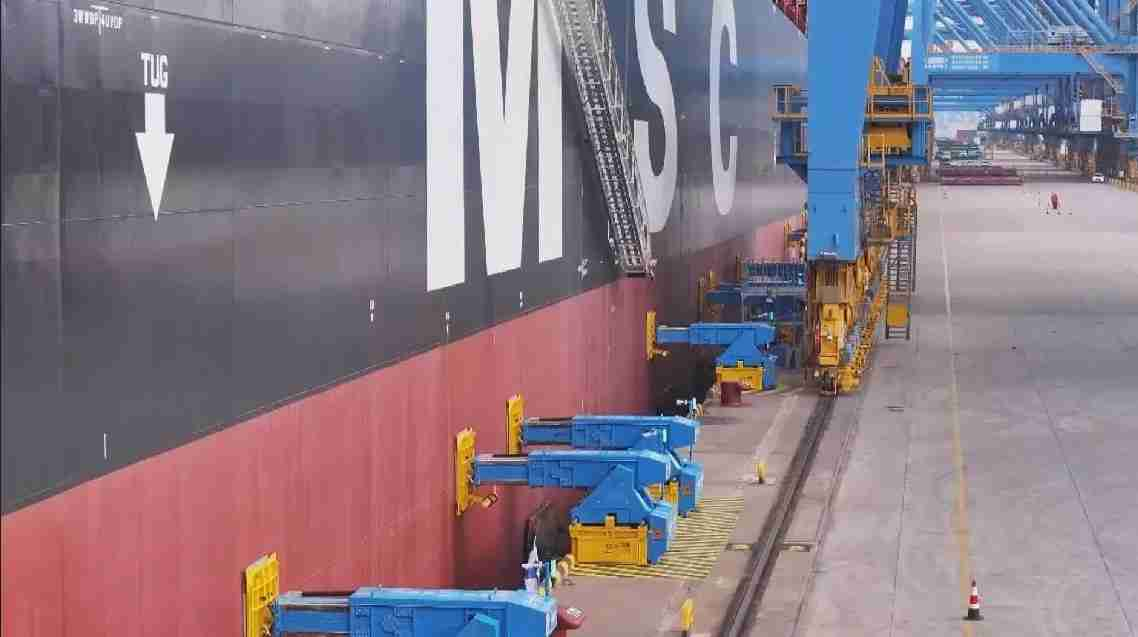
Initial live use of the system took place during the arrival of the 366 m container vessel MSC Saudi Arabia. In place of traditional mooring lines and quay-side line handlers, high-vacuum suction pads locked onto the ship’s hull and secured the vessel in under 30 seconds, compared with the 20–30 minutes normally needed for a ship of that size.
A representative of Qingdao Port, speaking to Chinese state media, noted that the solution enables fully automated mooring and release of large container ships through intelligent sensing and control, shortening berth time and improving operational safety.
Reports from CCTV and China News Service state that the berth is fitted with 13 vacuum mooring units distributed along the quay, delivering a combined holding force of about 2,600 kN. This capacity supports safe berthing of container vessels over 200 m in length, including ultra-large ships already in operation.
The installation is managed via a three-layer control structure linking a remote command centre, mobile management terminals and local control units. Integrated sensors and control algorithms monitor ship motion together with wind, wave and current conditions in real time, automatically adjusting the system to keep the vessel securely positioned alongside, according to port officials quoted by China News Service.
With line-handling crews no longer required on the quay apron, one of the higher-risk work areas at the berth is removed. Qingdao Port estimates that the automated mooring technology can free up more than 200 hours of berth time per position each year, potentially accommodating over ten additional vessel calls annually without extending the physical quay. With the system now operating in a live terminal environment, Qingdao Port becomes the first port in China to deploy vacuum-based automatic mooring, demonstrating that berth-side automation can be carried through to the final stage of securing the ship.