NYK Group used the World Maritime Merchants Forum 2025 in Hong Kong to present a fleet transition strategy centred on ammonia. President and CEO Takaya Soga began by underscoring the company’s direct operational experience with the fuel. He pointed to the ammonia-powered tug Sakuyake, which completed a three-month trial in March 2025 and achieved up to a 95% cut in GHG emissions. NYK views these results as early confirmation that ammonia can be used without harmful emissions, although the wider sector continues to flag toxicity as a handling concern.
Operational capability was another focus. Soga noted that NYK is steadily expanding its practical know-how, citing a ship-to-ship ammonia transfer conducted in September 2025 between the Berlian Ekuator and Eco Enchanted off Spain. He described the operation as demonstrating the feasibility of moving large quantities of ammonia safely at sea.
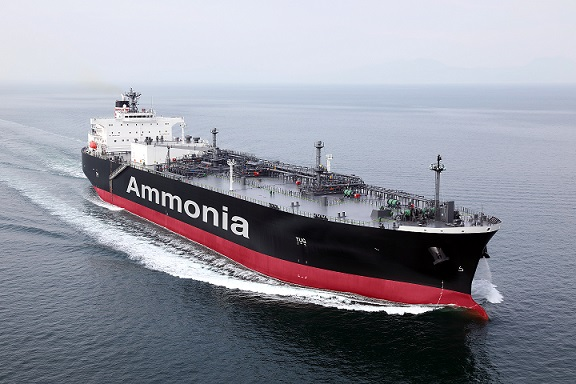
With these examples of readiness established, Soga moved on to NYK’s longer-term fuel plan. The company expects ammonia-fuelled vessels to enter its fleet from 2025 and to grow gradually toward 2050. LNG and LPG vessels are projected to reach their highest deployment around 2035 before giving way to ammonia-based propulsion. Methanol is scheduled to join the mix from about 2030, though on a smaller scale.
This trajectory differs significantly from current market behaviour. Industry orders this year total 147 LNG-powered and 47 methanol-powered ships, while only five ammonia-fuelled vessels have been placed. Despite this imbalance, Soga said NYK views ammonia as its principal pathway to zero-carbon deep-sea operations.
Cost, however, remains the dominant barrier. Soga noted that although the infrastructure required for ammonia-fuel use is already largely in place, blue and green ammonia remain far more expensive than conventional fuels. He added that extensive grey ammonia production facilities worldwide could support the eventual transition to cleaner variants. Accelerated development and scaled production, he said, are essential to reducing prices.
NYK’s position signals confidence in ammonia’s long-term potential for maritime decarbonisation, even as the sector continues to debate fuel costs, safety and alternative pathways.