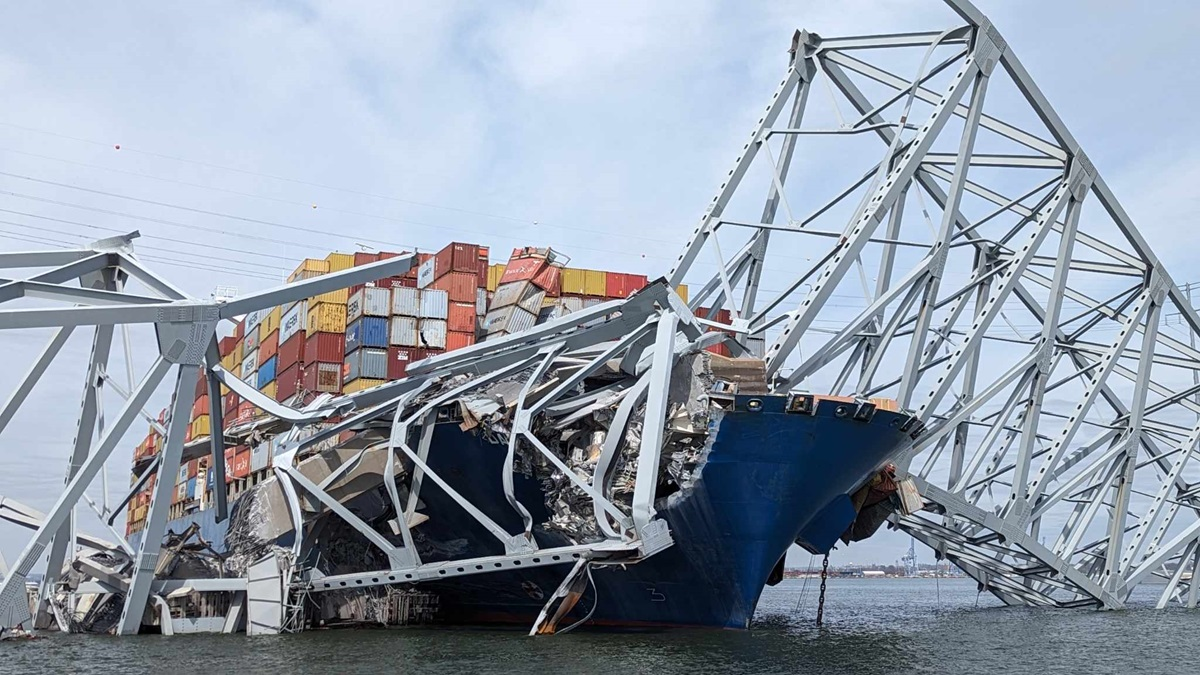
The National Transportation Safety Board (NTSB) will hold a public meeting on 18 November to determine the probable cause of the Francis Scott Key Bridge collapse in Baltimore, following a catastrophic allision involving the containership Dali that killed six people.
The Panama-flagged vessel was departing Baltimore Harbor for Sri Lanka in the early hours of 26 March 2024 when it lost electrical power and propulsion. Travelling at roughly 6.5 knots, the 984-foot ship struck the bridge’s southern pier at 01:28, causing the central spans to fall into the Patapsco River.
NTSB investigators reported that multiple electrical faults aboard the Dali triggered two blackouts as the ship neared the bridge. Breakers HR1 and LR1 tripped unexpectedly, shutting down propulsion and steering systems. A loose connection in the control circuit for HR1’s undervoltage release was identified as a likely source of the failure. The vessel had also experienced two power losses while docked the previous day.
Despite attempts to restore power, the ship suffered a full blackout moments before impact. Pilots issued a mayday, prompting police to close traffic access to the bridge. Of the eight people on the bridge, six highway construction workers died, one sustained serious injuries, and one inspector escaped unharmed.
The NTSB also revealed that the Francis Scott Key Bridge’s collision risk was nearly 30 times higher than acceptable safety limits for critical structures—a figure that could have been detected had the Maryland Transportation Authority conducted the required vulnerability assessment. Chairwoman Jennifer Homendy criticized the agency’s failure to evaluate and share essential safety data.
Following the incident, the NTSB identified 68 bridges across 19 U.S. states requiring immediate risk assessments, including major crossings such as the Golden Gate Bridge, Chesapeake Bay Bridge, and Verrazano-Narrows Bridge. These structures were built before modern design standards for vessel impact resistance were established.
Cleanup and recovery operations in early 2025 exceeded $100 million, with legal claims and insurance disputes expected to continue for years.
During the 18 November session, NTSB board members will vote on their findings, final cause determination, and safety recommendations. A meeting synopsis will be released afterward, and the complete final report will be published within weeks on the agency’s website.
If a federal government shutdown prevents live streaming, the NTSB will post a video recording of the meeting on NTSB.gov. Chairwoman Homendy is expected to brief reporters 30 minutes after the session concludes.