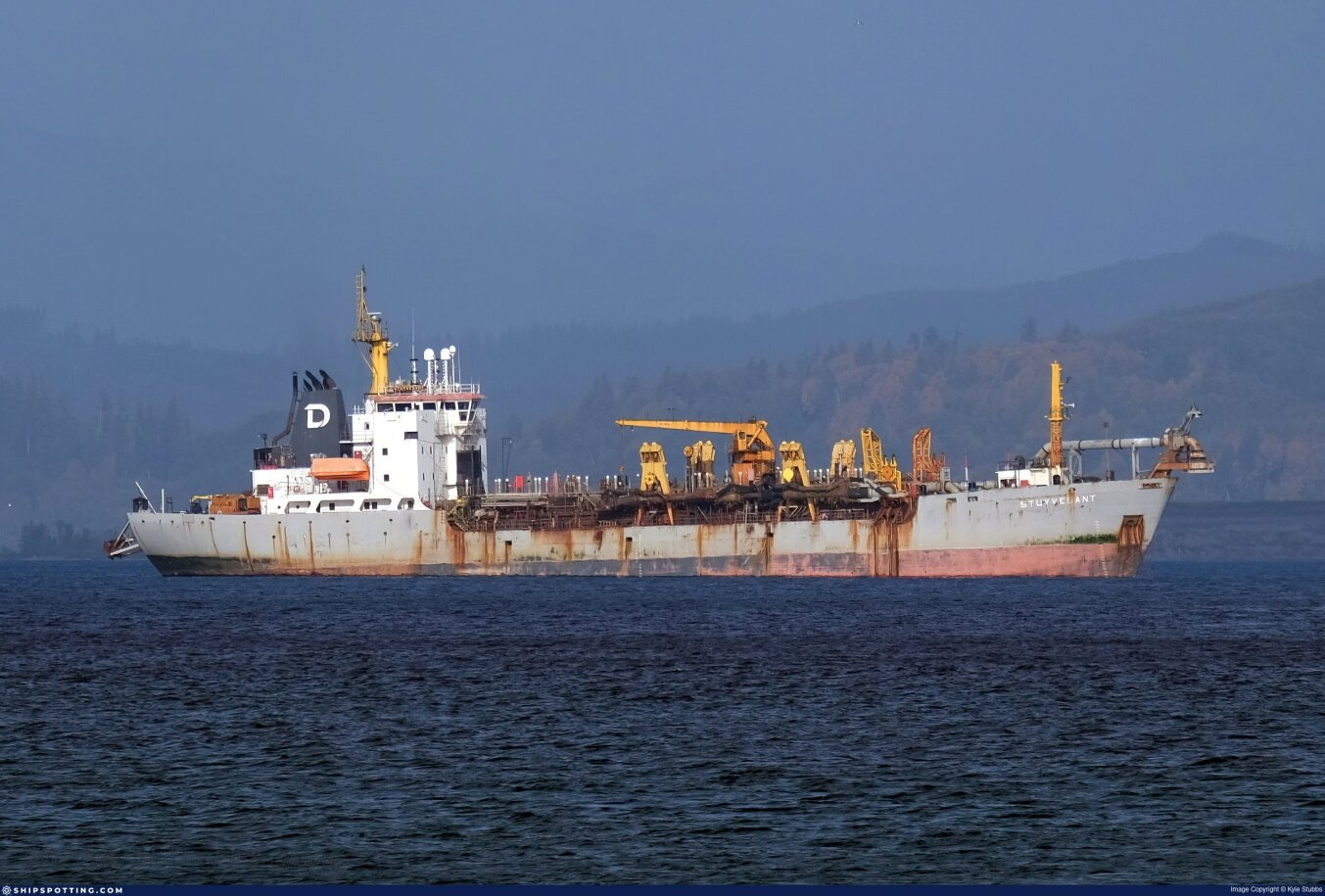
A fatal engine room fire aboard the dredging vessel Stuyvesant in November 2024 was caused by maintenance oversights and a remote engine start, according to the U.S. National Transportation Safety Board (NTSB). The incident killed one crewmember and resulted in an estimated $18 million in damage.
On 2 November 2024, at approximately 1435 local time, the 392-foot hopper dredger was holding position in the St. Johns River near Jacksonville, Florida, when fire erupted in its engine room. Twenty-two crewmembers were on board. Two engineers were in the machinery control room at the time: one escaped, while the other was rescued by the emergency squad but was later pronounced dead at a local hospital.
Investigators found that the fire originated from lube oil spraying from a port auxiliary diesel generator and igniting on hot exhaust surfaces of a nearby running main engine. The spray occurred because engineers failed to reinstall a plug in the lube oil filter housing after routine maintenance and started the engine remotely. The manufacturer’s instructions required reinstalling the plug and recommended a walk-around inspection before startup; the NTSB also emphasizes starting locally after maintenance.
The lube oil, pressurized to about 65 psi, escaped through the open threaded port, contacting surfaces with temperatures between 614°F and 742°F, which exceeded the oil’s ignition point. Flames appeared less than a minute after the engine was started.
The investigation determined that crew maintenance on the port 2,442-horsepower Caterpillar 3512C auxiliary engine included replacing fuel and lube oil filters and changing sump oil. The missing plug, later found on a nearby cabinet, was among several lapses. The lube oil filler cap was also left open, and the crew did not complete the manufacturer-recommended walk-around inspection before starting the engine.
The NTSB stated that the first engineer initiated the start-up sequence remotely from the control room, which prevented anyone from observing the engine locally during the process. “If the engine had been started locally,” the agency noted, “a crewmember would have been near the engine and could have seen oil discharging from the open port and stopped the start sequence.”
Investigators also highlighted that the engineering team had experienced work disruptions before the fire. The maintenance, initially planned for the previous day, was delayed, and the team’s composition changed on the day of the casualty when one member became ill. The NTSB wrote that such interruptions can cause “steps in the sequence to be overlooked or missed, especially in teams where roles are not clearly defined.”
The ship’s crew contained the situation before it escalated further. The port auxiliary engine was shut down about 2.5 minutes after the fire began, removing the immediate fuel source. At 1439, the chief engineer stopped the main engines, halting power generation and ventilation fans, which reduced oxygen in the engine room. By the time the emergency squad entered around 1457, no active flames were visible. After verifying that the space was sealed, the fixed CO₂ fire suppression system was released.
No pollution resulted from the incident, but damage to the vessel was extensive.
Following the casualty, The Dutra Group, operator of the Stuyvesant, introduced new operational requirements. Engines must now be started locally after any maintenance, and two crew members are required to perform pre-start inspections.
The Stuyvesant, built in 1982 by Avondale Shipyard in New Orleans, was equipped with new auxiliary engines in December 2022 to replace older units nearing the end of their service life.
The NTSB concluded that the probable cause of the fire was the failure to reinstall the lube oil filter housing plug and to properly inspect the engine before restarting it, resulting in oil spraying onto hot components.
The investigation report reiterated a key lesson for marine engineers: after maintenance, machinery must be carefully inspected and started locally to confirm normal operation and ensure there are no leaks, abnormal noises, or vibrations.
Source: National Transportation Safety Board Investigation Summary