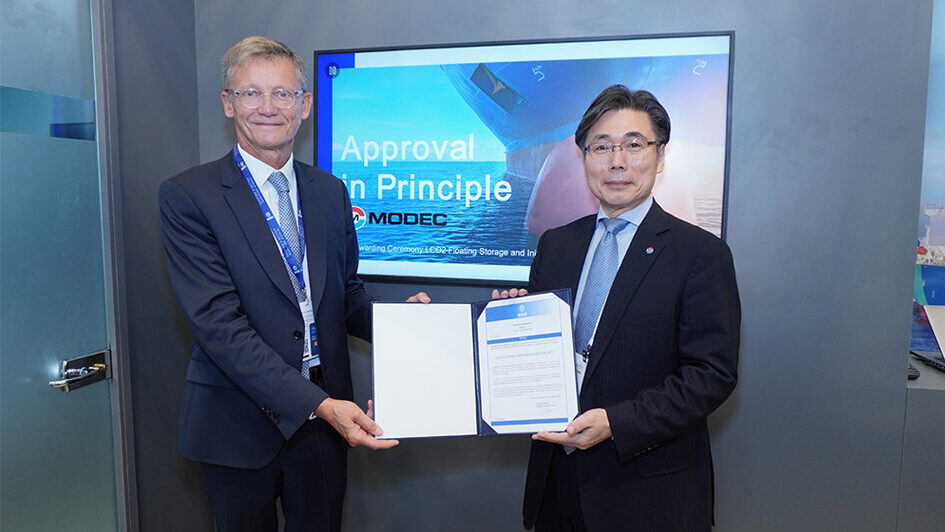
Tokyo-based MODEC has secured an Approval in Principle (AiP) from Bureau Veritas Marine & Offshore for its new Floating Storage and Injection Unit (FSIU) designed to handle liquefied carbon dioxide (LCO₂). The announcement was made during Gastech 2025 in Milan.
The FSIU is engineered to receive LCO₂ transported under low-pressure conditions, temporarily store it in tanks with a minimum capacity of 100,000 m³, and inject it into subsea wells at high pressure for permanent storage. With a planned injection capacity of up to 10 million tonnes per year, the offshore unit eliminates the need for onshore CO₂ receiving plants and pipeline connections to reservoirs.
To ensure operational flexibility, the FSIU will support both tandem loading at the stern—handling LCO₂ carriers up to 90,000 m³—and side-by-side loading at midship for vessels up to 50,000 m³. The hull was developed with Mitsubishi Shipbuilding, while SOFEC designed the external turret mooring system to enable dual loading and reliable station keeping in variable offshore conditions, particularly in Southeast Asia.
The unit will also feature diesel engine generators with an integrated carbon capture system, aiming to minimize its own emissions.
The concept was jointly developed with Mitsui O.S.K. Lines (MOL), leveraging MOL’s expertise in LCO₂ transport and offloading, and MODEC’s track record in FPSO design, hull construction, and offshore mooring.
Bureau Veritas’ review assessed safety and regulatory compliance across hull, mooring, storage, and injection systems, validating the technical feasibility of the design.
MODEC executives noted that while the FSIU represents a new application, its systems build on proven FPSO and CO₂ injection technologies. The project is intended to serve as a scalable offshore hub for carbon sequestration, supporting global decarbonization efforts.