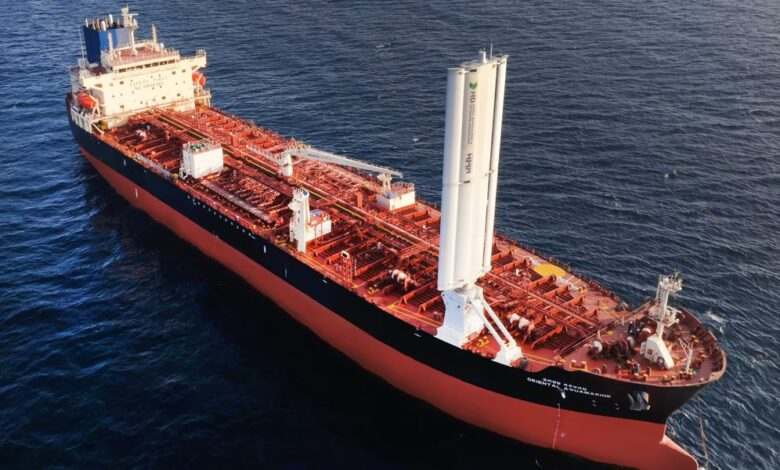
Korean shipping and shipbuilding companies are strengthening cooperation around wind-assist propulsion technology as HD Korea Shipbuilding & Offshore Engineering (HD KSOE) moves a self-developed wing sail system from shoreside testing to open-water trials on an HMM vessel. The company, a mid-level shipbuilding holding unit under HD Hyundai, has installed a prototype Wing Sail on the MR tanker Oriental Aquamarine and started a dedicated sea trial programme.
The trials are being conducted on the 50,000 dwt Oriental Aquamarine following a series of onshore evaluations. Before the sail was fitted, the unit underwent structural safety checks and basic performance validation. Classification society Korean Register completed its inspection ahead of the trials, and HD KSOE said initial runs at sea have confirmed that the system is operating as intended.
The wing sail is a wind-assist device that uses aerodynamic lift, similar to an aircraft wing, to provide additional thrust. Standing about 30 m high and 10 m wide, the structure incorporates auxiliary foils on both sides to improve utilisation of the wind. A mechanism that allows the sail to tilt and fold means it can be lowered in heavy weather or when passing under bridges, providing greater flexibility and supporting safe operation.
According to HD KSOE, the current sea trials are aimed at measuring real-world behaviour, including fuel-consumption benefits and associated carbon-emission reductions, under a range of sea and weather conditions. Data from the programme will be used to refine the design and move toward a commercial version of the technology.
Based on trade routes and prevailing weather, HD Hyundai estimates the wing sail could deliver fuel savings of 5–20%. HMM plans to track performance over roughly two years, using operational data gathered from the Oriental Aquamarine, and is considering broader application of the system across its bulk fleet, depending on the outcome.