South Korea’s plan to create a unified artificial intelligence (AI) autonomous navigation system with its leading shipbuilders is encountering resistance, as major yards seek to protect technologies they have developed independently at substantial cost.
The discussion gained momentum after Deputy Prime Minister for Economic Affairs and Minister of Economy and Finance Koo Yun-cheol announced that the government “will push to develop AI autonomous navigation vessels in partnership with the three major shipbuilders,” according to shipbuilding industry sources.
In response, large shipyards including Hanwha Ocean, HD Korea Shipbuilding & Offshore Engineering, and Samsung Heavy Industries have begun limited cooperation focused on data collection. The companies are working together to build datasets covering environmental variables such as waves, wind, and currents, as well as operational information, including AIS signals, engine revolutions, and radar readings.
Many in the sector, however, question whether collaboration can move beyond this basic layer. On a four-step scale for autonomous navigation — where the fourth step is fully unmanned navigation — South Korean shipbuilders are regarded as approaching step three, which corresponds to shore-based remote control of unmanned vessels. With development already at this advanced stage, companies are wary of aligning R&D strategies that have so far been pursued independently.
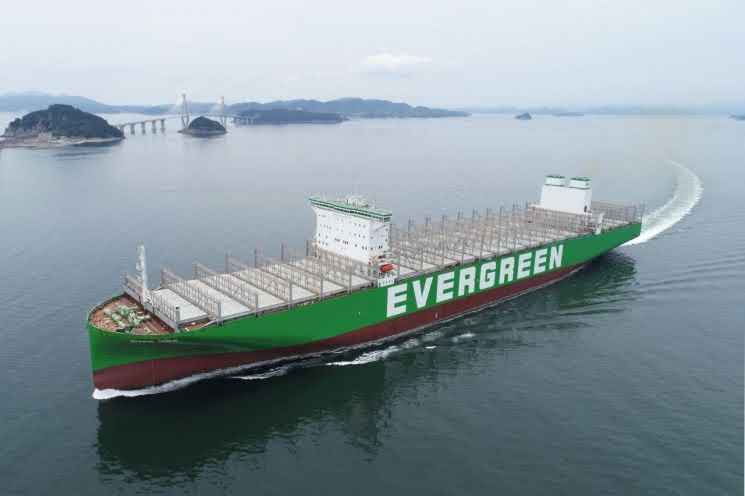
Each yard has followed its own technological path. In September, Samsung Heavy Industries installed its in-house AI autonomous navigation suite, SAS (Samsung Autonomous Ship), on a 15,000-TEU container ship operated by Taiwan’s Evergreen, with TEU indicating capacity in units of a standard 20 ft container. The vessel then successfully completed a demonstration voyage across the Pacific.
HD Korea Shipbuilding & Offshore Engineering has also been pushing its own solution. Through HD Hyundai’s autonomous navigation subsidiary Avikus, the “HiNAS Control” system has been applied to ships since 2023, with trials showing that carbon output fell by 15%, while fuel efficiency improved by 15%.
Differences in technical focus among shipbuilders are cited as a key obstacle to deeper cooperation. One company may prioritise real-time optimisation of routes using data on wave height, wind, currents, reefs, GPS signals, and other ships’ routes, while another concentrates on robust data exchange with an onshore control centre. With priorities and development directions diverging, executives argue that designing a single shared system without weakening individual strategies is difficult.
There is also scepticism about treating navigation software as a jointly developed platform rather than a core product feature. From the perspective of shipbuilders, the operating system that underpins autonomous navigation is a crucial sales differentiator that must stand apart from rival offerings, making the government’s request for collective development hard to accept.
An industry official noted that autonomous navigation technology, similar to autonomous driving systems at finished carmakers, has been built up by each company through large-scale investment. The official added that shipyards view these systems as clear trade secrets, which makes it difficult for them to agree to merge their technologies into one unified system.
Lee Hee-su, shipbuilding and marine PD at the Korea Planning & Evaluation Institute of Industrial Technology (KEIT), said that if the government wants a collaborative AI-based autonomous navigation effort to progress, it will have to offer concrete incentives. In his view, only sufficiently strong incentives will persuade shipbuilders to put forward and use technologies that have required massive spending to develop.