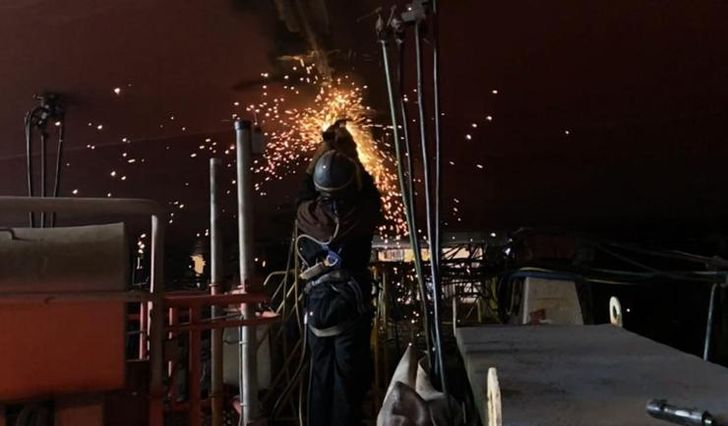
At Hanwha Ocean’s Okpo shipyard on Geoje Island, a pipe-welding station that once demanded awkward postures and constant heat exposure has been reorganized around a collaborative robot. A worker sets a guide and initiates the sequence, then monitors welding conditions and makes fine adjustments from a short distance away—illustrating how on-site roles are shifting from manual execution toward process control as automation expands.
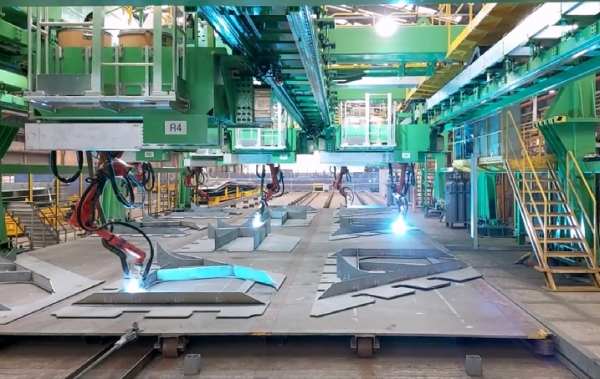
A similar transition is taking shape in Ulsan. Inside HD Hyundai Heavy Industries’ Yongyeon Factory in Nam-gu, ceiling-mounted welding robots have been introduced to small-scale assembly, an early production stage where smaller ship structures are built before block assembly. In one operating setup, steel members around 1.5 m long are arranged in parallel rows with 80 cm spacing, while four robots move overhead to weld joints continuously. The yard’s comparison for a 1.2 m weld seam is 15 minutes by hand versus five minutes by robot.
According to site-level performance figures, the impact has been tangible. Robots were introduced to the Yongyeon line in November 2024, replacing a workflow in which six skilled workers welded about 500 tonnes per month. With four robots running from 08:00 to 04:00 the next day, monthly throughput has increased to 900 tonnes, described as a productivity gain of more than 80%. The current phase focuses on accumulating production data so AI can model material characteristics, with a subsequent stage aimed at allowing AI systems to select optimal welding paths autonomously.
Across its shipyards, HD Hyundai has deployed about 200 robots, including industrial and collaborative units, as automation spreads into repetitive and high-risk tasks. One of the most advanced applications is lug manufacturing—hooking components used to lift and move blocks by crane. Each vessel requires roughly 2,000 lugs, which skilled workers previously fabricated. In the automated line, 3D vision AI identifies position and geometry with up to 0.1 mm precision, while robots perform cutting, alignment, and welding. Material transport and post-use lug servicing have also been automated. The company has estimated annual cost savings of approximately KRW 500 million from the lug process and plans to expand automated production from three high-demand lug types to 43 types by 2026.
Other Korean shipbuilders are advancing similar initiatives. Samsung Heavy Industries has announced a collaboration with Rainbow Robotics to develop shipyard-capable robot platforms, including mobile dual-arm and quadruped systems. In parallel, Hanwha Ocean has outlined investments aimed at building a data-driven “smart yard” that integrates robots and AI across production processes.
Shipbuilders described the initiatives as responses to shortages of skilled welders and rising safety risks in high-burden processes. Shipbuilders noted that automation has historically been limited by large block sizes, process variability, and outdoor working conditions typical of shipyards. In industry briefings, these projects have been presented under the “M.AX (Manufacturing AI Transformation)” framework, which emphasizes AI-supported decision-making and process optimization rather than simple task automation.
Source: The Chosun Daily, Asia Business Daily