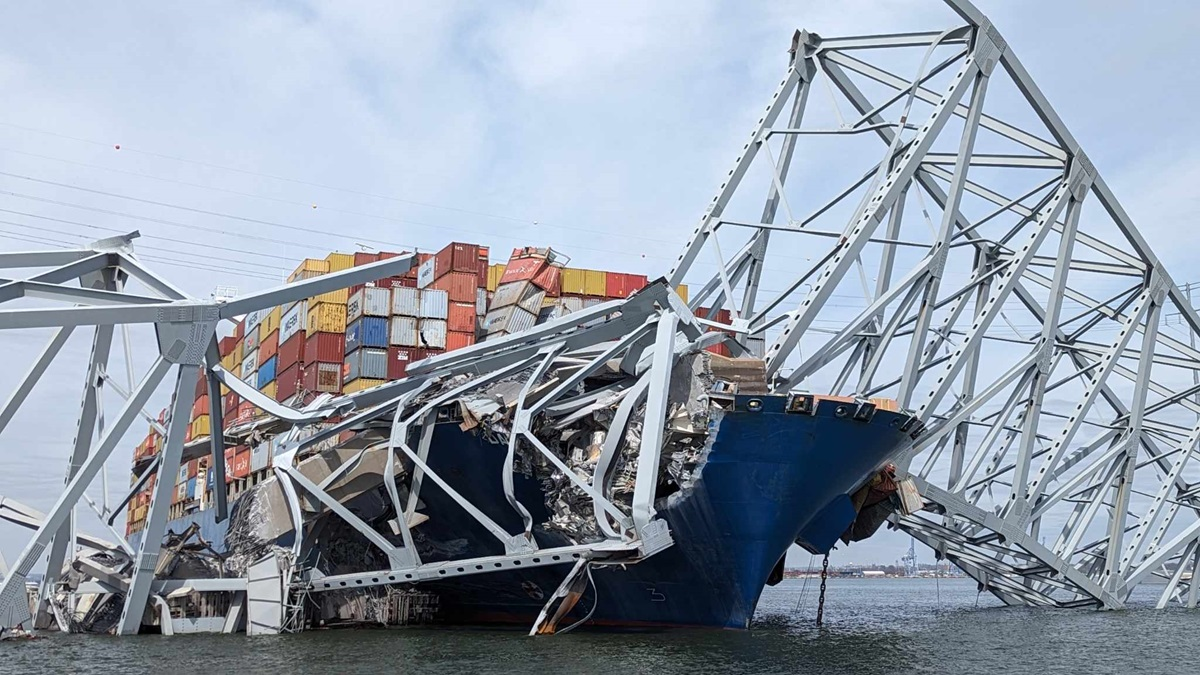
HD Hyundai says modifications made after delivery of the containership M/V Dali undermined built-in safeguards and contributed to the second blackout that left the vessel without propulsion or steering moments before it hit Baltimore’s Francis Scott Key Bridge on 26 March 2024. Six highway workers were killed in the collapse.
The statement from HD Hyundai Heavy Industries follows the National Transportation Safety Board’s (NTSB) investigation, which found that the likely cause of the collision was a loss of electrical power traced to a loose signal wire. The wire had come free because of incorrect installation of a wire-label band, leading to a loss of propulsion and steering as the ship neared the bridge. The NTSB also urged HD Hyundai Heavy Industries to update its electrical department procedures to include proper wire-label banding practices.
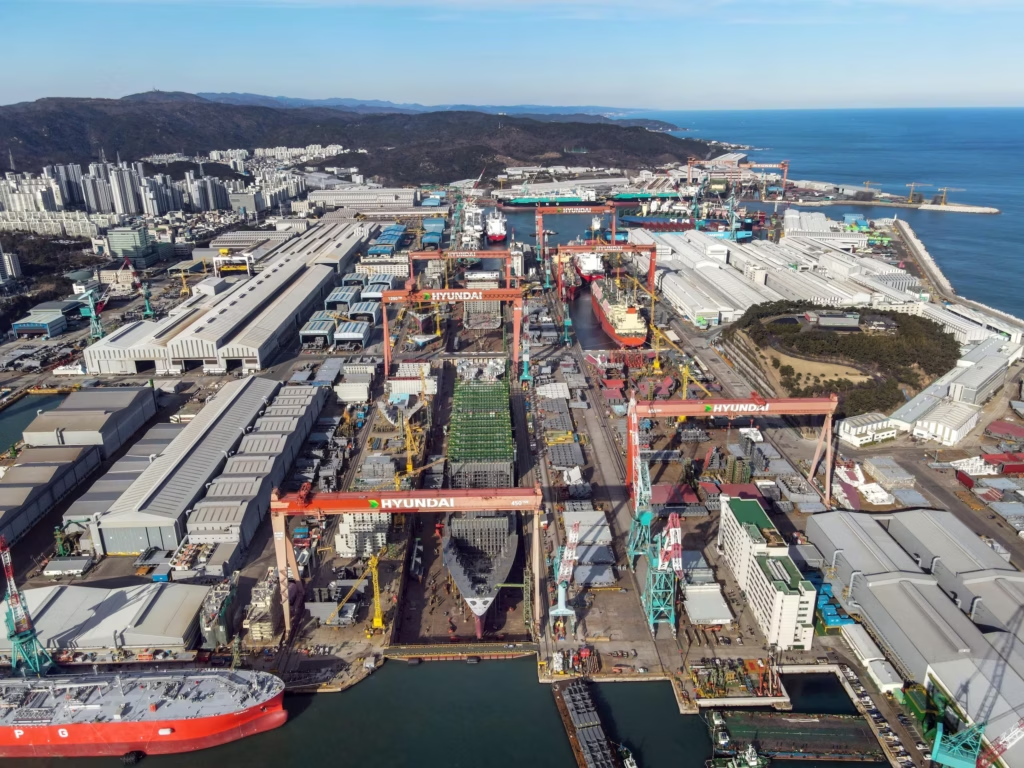
In its response, the South Korean yard defended the original design of M/V Dali, saying the ship was delivered with multiple independent power sources and automatic restart logic to avoid a total loss of power. The company noted that large container vessels, described by the NTSB as “floating cities,” carry their own power plants and are built with protections to deal with the complexity of operating in a harsh marine environment.
According to HD Hyundai, the vessel left the yard with four separate diesel generators, two independent transformers and fuel supply pumps set to automatic mode so they would restart after a power failure without crew action. The shipbuilder said these layers of redundancy are required under the rules of the relevant classification society.
The company alleges that “some time after taking possession” of M/V Dali, the shipowner and operator altered the configuration, “compromising its critical redundancies.” In particular, HD Hyundai says the operators installed an electrical flushing pump in place of the automatic fuel supply pumps. The flushing pump, which was designed for system cleaning rather than continuous fuel service, had to be started manually and did not include the same built-in protections.
See also: NTSB: Improper Label-Band Placement Caused Dali Blackout and Key Bridge Collapse
The statement argues that running the flushing pump as the main fuel pump removed both redundancy and automatic recovery in the fuel system and conflicted with class requirements.
On the day of the bridge strike, the vessel suffered two separate blackouts. The first outage occurred when a wire disconnected from a terminal block in the transformer system. Because the transformer was being used in manual rather than automatic mode, the crew had to switch to the standby transformer by hand. During this changeover, HD Hyundai says the crew did not restart the flushing pump that was feeding fuel to the running generators, cutting off their fuel supply and causing a second blackout.
The shipbuilder maintains that if the original systems had been left in place and operated as designed, power would have come back within seconds and “the second blackout, which led to the tragedy, would not have happened.”
The NTSB report also criticised how the vessel was being run. While the agency said this was not the cause of the initial loss of power, it found that using the flushing pump as the service pump for the online diesel generators was inappropriate because fuel pressure for generators 3 and 4 could not be restored automatically after a blackout.
The NTSB explained that the flushing pump did not restart after the first loss of power and stopped supplying pressurised fuel to generators 3 and 4, which in turn caused the second blackout affecting both low- and high-voltage systems. The report concluded that operational oversight by Synergy, the ship’s operator, was inadequate.
Investigators also pointed out that regular inspection over the preceding decade should have identified the loose wire. HD Hyundai stressed in its statement that it was the responsibility of the owner and operator to carry out ongoing inspection and maintenance so that onboard systems and components remained seaworthy.
Beyond the ship’s technical and operational issues, the NTSB cited additional contributing factors, including the absence of protective structures around the bridge and poor communication to warn road workers to evacuate. The board issued urgent recommendations to several federal agencies and bridge owners across the United States to review their structures’ vulnerability and implement risk-reduction measures.
In closing, HD Hyundai said the shipowner and operator used M/V Dali’s systems in ways that departed from the intended design and failed to meet their continuing obligations for inspection and maintenance. The company said this amounted to taking shortcuts and breaching class rules, and that this behaviour contributed to the incident. HD Hyundai offered condolences to the families of those killed and said it would keep working with authorities to prevent similar accidents.