
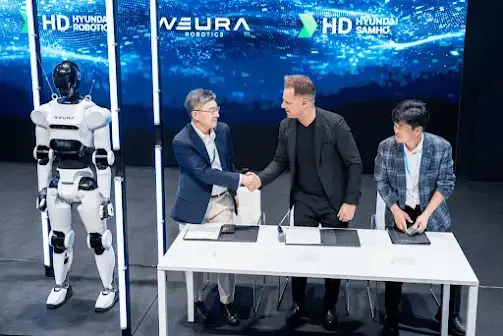
HD Hyundai is stepping up its automation strategy to counter persistent skilled labor shortages at shipyards, advancing multiple robotics programs in parallel. Shipbuilder HD Hyundai Samho Heavy Industries and automation affiliate HD Hyundai Robotics have entered a strategic partnership with Germany’s NEURA Robotics to co-develop and test humanoid and quadrupedal robots for shipyard applications, starting with automated welding.
Under the collaboration, Samho will provide real-world demonstration and validation environments, HD Hyundai Robotics will contribute welding path-learning datasets and performance verification expertise, and NEURA will deliver cognitive humanoid technologies and commercialization planning. No commercialization date for this track has been disclosed.
Separately, in May 2025, HD Korea Shipbuilding & Offshore Engineering (HD KSOE) and HD Hyundai Robotics signed an MoU with Houston-based Persona AI and Busan-based Vazil to develop a humanoid welding robot tailored to shipyard environments. The program targets prototype completion by late 2026 and field testing and commercial deployment from 2027, with clearly defined roles: Persona on hardware/AI, Vazil on welding tools and testbed build-out, HD Hyundai Robotics on data and performance verification, and HD KSOE on shipyard deployment support.
Live trials are already underway. At Samho’s yard, NEURA’s humanoid system is being tested on welding and block assembly tasks that require precision, repeatability, and safety in challenging industrial conditions.
The automation push is driven by a well-documented manpower gap. Industry and policy sources note that South Korea’s shipbuilding sector has faced annual shortfalls in the 10,000–14,000 range in recent years, and projections suggest the total workforce required could reach around 135,000 by 2027. In response, the government has expanded training programs and eased visa requirements for foreign workers.
