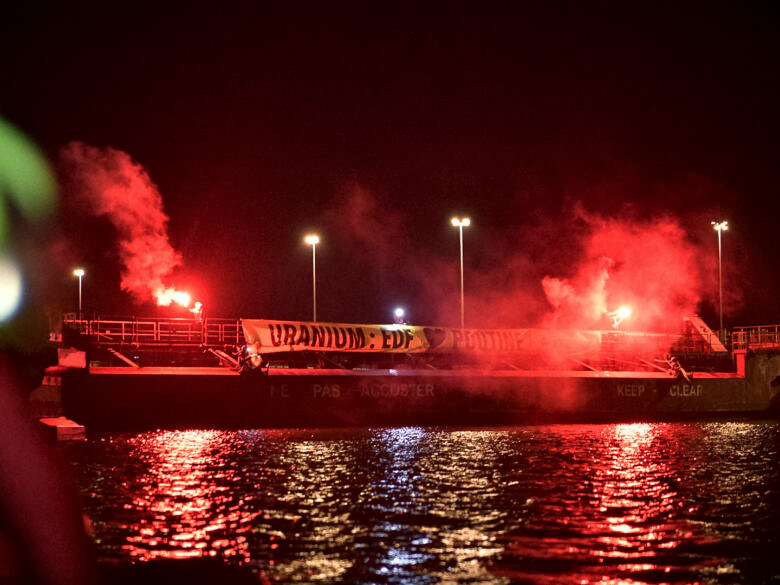
French police detained four people after Greenpeace France activists blocked a lock gate leading into the Port of Dunkirk on 2 March, delaying the arrival of a cargo ship protesters said was carrying uranium. The action lasted about four hours before it was cleared, and the port resumed normal operations by 0900, allowing the ship to dock.
About 20 protesters took part, using kayaks and Zodiacs while others chained themselves to the gate. Greenpeace France said the protest aimed to press France to end uranium imports from Russia and halt involvement with Rosatom, calling for greater transparency on the trade and for EDF to terminate contracts with the Russian nuclear company. The timing was linked to the World Nuclear Summit in Paris on 10 March.
The Panama-flagged cargo ship Mikhail Dudin (3,000 dwt) was due to arrive from Saint Petersburg. Protesters said it was likely carrying enriched or natural uranium for delivery to EDF and its subsidiaries. They also displayed signs urging EDF to stop imports and arguing the trade indirectly supports Russia’s war in Ukraine.
Greenpeace France said it tracked at least 20 trips by Mikhail Dudin between Russia and France over the past four years since the war began in Ukraine, and said a second cargo ship, Baltiyskiy, made another 15 trips over the same period. The report also said France imported at least 112 tonnes of enriched uranium and its compounds from Russia, accounting for about a quarter of purchases by volume, with volumes declining between 2022 and 2024 but remaining stable over the past two years.
The report said EDF is honoring a contract it signed with Rosatom in 2018 and described Russia as the only country with a plant capable of taking France’s used uranium for reprocessing—converting it and then re-enriching it for reuse. It also said EU sanctions on Russia have not included the nuclear sector, while Greenpeace France alleges France is blocking sanctions against Rosatom and is urging Paris to support adding it to sanctioned trade.