Fremantle, Western Australia, 3 November 2025 — The Australian Transport Safety Bureau (ATSB) has determined that inadequate bridge resource management and communication failures were central to the collision between the containership Maersk Shekou and the moored tall ship Leeuwin II in Fremantle Harbor on 30 August 2024.
The 333-meter Singapore-flagged containership was entering Fremantle’s inner harbor under the guidance of two pilots during severe squalls when the incident occurred. The vessel’s primary pilot, who was reportedly fatigued, handed control to the backup pilot before entering the narrow channel. Despite challenging conditions with gusts reaching 54 knots, the ship proceeded with four assisting tugs.
At approximately 0610, strong southwesterly winds pushed on the vessel’s starboard quarter as it transited the inner harbor entrance. The helmsman followed orders to maintain a heading of 083 degrees but received no subsequent command to alter course to port, a maneuver required to align with the passage plan. Data recovered from the vessel’s recorder later confirmed that the lead pilot failed to issue this rudder command.
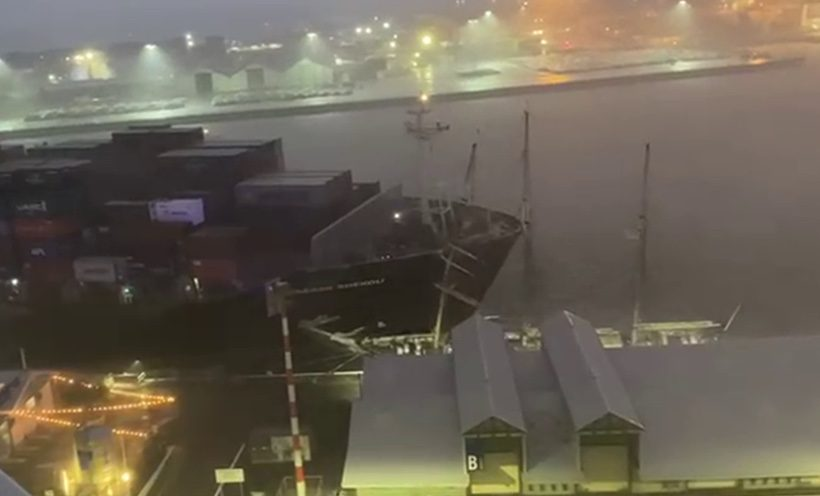
As the boxship continued on the uncorrected heading, it advanced toward Victoria Quay, directly toward the berthed Leeuwin II. Efforts by the pilot to correct the course using tug assistance, the bow thruster, and engine adjustments came too late. At about 0618, Maersk Shekou’s starboard bow struck the Leeuwin II’s rigging, dismasting the tall ship and injuring two crew members who were evacuating onto the pier. The vessel’s stern then swung toward the quay, striking the wharf and causing stacked containers to damage the roof of the Western Australia Maritime Museum. A six-foot (≈1.8 m) hull breach was later found above the waterline.
The ATSB investigation revealed that the bridge team lacked coordination and a “shared mental model” of the vessel’s intended movements. The team did not effectively monitor helm execution or the rate of turn, and they failed to identify or challenge the missed rudder order. The secondary pilot, distracted by a non-essential phone call with dispatch during the critical turning phase, was unable to intervene when the error occurred.
Investigators also identified that the final tug was being secured just moments before the missed turn—later than planned—adding workload and diverting attention from navigation. Wind speeds exceeding Fremantle Port’s operational limits further complicated control during the approach.
In addition to these immediate factors, ATSB found procedural lapses at the port level. The vessel entered the inner harbor channel before sunrise and without all tugs fully connected, in conditions surpassing documented wind restrictions. These deviations undermined established risk controls for large vessel entries.
“ATSB emphasizes that an effective bridge team requires all members to maintain a shared understanding of the vessel’s maneuvers and communicate any deviations or errors immediately,” Chief Commissioner Angus Mitchell said. “Minimizing distractions and reassessing risks when operational limits are exceeded are essential to safe navigation.”
The collision caused only minor structural damage to Maersk Shekou, and no injuries were reported among its crew or pilots. Both Fremantle Ports and the pilotage provider, Fremantle Pilots, have committed to implementing corrective safety actions based on the findings.