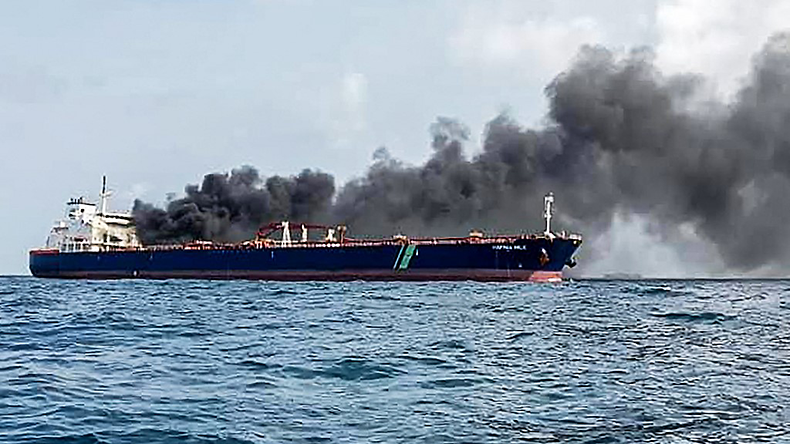
In the early hours of 19 July 2024, the tanker Hafnia Nile was making way northeastbound in the South China Sea, east of Malaysia, under fair weather and good visibility when it closed on the anchored tanker Ceres I. The developing traffic picture turned into a close-quarters emergency in minutes—ending in a collision, cargo and fuel releases, and a fire that spread across both ships and the surrounding sea surface.
The minutes before impact
According to the investigation conducted by Singapore’s Transport Safety Investigation Bureau (TSIB), Hafnia Nile entered open waters after departing Singapore and later encountered multiple targets along a commonly used route where ships were transiting, anchored, or drifting. In the final hour of the 0000–0600 watch, the Officer of the Watch (second mate) identified Ceres I ahead by radar and visually—deck lights visible, navigation lights not observed—and also tracked other traffic converging from the starboard side.
A key decision point came when Hafnia Nile’s bridge team considered passing through a narrowing gap: Ceres I and a southwest-bound ship were assessed at roughly 0.7 nm apart. As the approach continued, ARPA data indicated a rapidly reducing CPA with Ceres I, trending toward near-zero within a short TCPA window.
Instead of consolidating bridge attention on the close-quarters development, the OOW stepped into the chartroom within the bridge area to complete two administrative reports (IFC and AMVER). With the chartroom separated by curtains during darkness, the wheelhouse was effectively left to a single watchkeeper whenever the OOW was away from the conning position. This reduced situational awareness at precisely the point when continuous monitoring and timely action were most needed.
At about 0601H, the OOW returned to the wheelhouse and visually sighted a large ship close ahead—estimated at less than one cable—then shifted to manual steering and applied hard starboard rudder. The manoeuvre came too late. At about 0602H, Hafnia Nile’s bow contacted Ceres I’s port anchor chain; the chain entangled with Hafnia Nile’s port bilge keel, drawing the anchored ship closer and escalating the contact into a structural breach. Ceres I’s bulbous bow then breached Hafnia Nile’s shell plating near Heavy Fuel Oil Tank 1P and Cargo Oil Tank 6P, igniting a fire onboard both ships.
Why was the collision risk not arrested earlier
The findings point to a chain of human-element and system-use breakdowns rather than a single mistake.
Fatigue profile on the navigating ship. The second mate joined Hafnia Nile after an overnight travel and immediately entered a heavy workload during port activities. He had only about two hours of rest over a 38.5-hour period, with rest disrupted by an unannounced fire alarm test, before taking the midnight watch. The collision occurred in the last hour of that watch, when fatigue effects are typically amplified.
Degraded “safety net” from radar alarms. CPA/TCPA alarms on Hafnia Nile’s S-band radar were silenced, and alarms on the X-band radar were deactivated. With automated alerting reduced, the bridge team lost an important backstop for early detection of a reducing CPA—especially relevant when attention was divided, and the OOW intermittently left the wheelhouse.
Anchored-ship escalation limitations. Onboard Ceres I, the anchor watch team detected Hafnia Nile at about 6.4 nm and initially assessed low risk. As the situation tightened to close quarters, the bridge team reported using sound and light signals to warn the approaching ship. VHF communication was not attempted when the encounter escalated, and the SMS lacked specific guidance on the communication methods to be used in such a scenario.
What happened after the collision
The impact triggered a fire that spread across both ships and the sea surface. Two shore workers onboard Ceres I sustained severe burn injuries, and one later died in the hospital.
On Hafnia Nile, the damage assessment attributed cargo and bunker losses to breaches near COT 6P and HFOT 1P, including about 4,065.4 t of naphtha and about 565 t of VLSFO, with a contaminated oil-water mixture later collected using a slop barge.
Singapore’s maritime authorities said they were alerted around 0615 on 19 July to the fire onboard both vessels within Singapore’s Maritime Search and Rescue Region and coordinated assistance. In follow-up updates days later, authorities said additional towing and response assets were deployed, light oil sheens were observed near Hafnia Nile, and containment and clean-up planning formed part of towage planning. A subsequent parliamentary reply stated that navigational traffic in the vicinity was not affected and that incident-related pollution had not been detected reaching Singapore’s coastline at that time.
This case underscores how quickly a manageable traffic situation can become unrecoverable when fatigue, divided-bridge attention, and muted warning layers coincide—especially in waters where anchored ships sit close to established transit routes. It also reinforces the need for clearer, practiced escalation on anchored vessels, because early, unambiguous communication may be the last opportunity to interrupt a developing collision chain.