
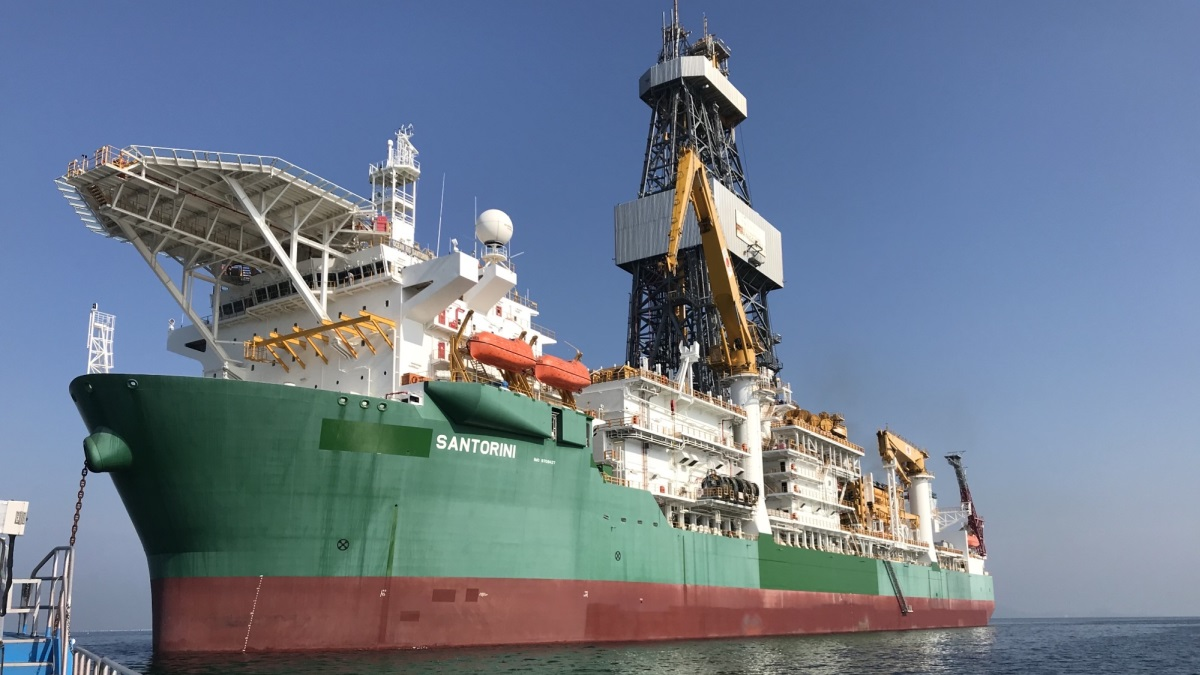
On 16 February 2026, Eni reported a gas and condensate discovery offshore Côte d’Ivoire after successfully drilling Murene South-1X, the first exploration well in Block CI-501.
Named Calao South, the discovery confirms the potential of the Calao channel complex, which also includes the Calao discovery. Eni estimated volumes of up to 5.0 Tcf of gas and 450 million barrels of condensate, equivalent to approximately 1.4 billion barrels of oil. The accumulation was identified in high-quality Cenomanian sands and is described as the country’s second-largest discovery after Baleine.
Block CI-501 is operated by Eni (90%) with Petroci Holding (10%). Murene South-1X sits around 8 km southwest of the Murene-1X discovery well in the adjacent CI-205 block. The well was drilled by the Santorini drillship to a total depth of around 5,000 m in 2,200 m of water depth, alongside an extensive data acquisition programme.
According to Eni, Murene South-1X confirmed the main hydrocarbon-bearing interval with a gross thickness of about 50 m and excellent petrophysical properties. A full conventional drill stem test (DST) is planned to assess the production capacity of the Calao discovery.
Baleine currently produces over 62 thousand barrels of oil and more than 75 million cubic feet of gas per day from Phases 1 and 2. With the launch of Phase 3, production is expected to rise to 150 thousand barrels of oil and 200 million cubic feet of gas per day, reinforcing Baleine as a key asset for meeting Côte d’Ivoire’s domestic energy needs.
Eni has operated in Côte d’Ivoire since 2015. Beyond CI-501, the company holds interests in nine other exploration blocks: CI-205, CI-504, CI-526, CI-706, CI-707 and CI-708 in partnership with Petroci Holding, as well as CI-401, CI-801, CI-802 and Baleine AEE in partnership with Petroci Holding, Vitol and SOCAR, subject to governmental approvals.
