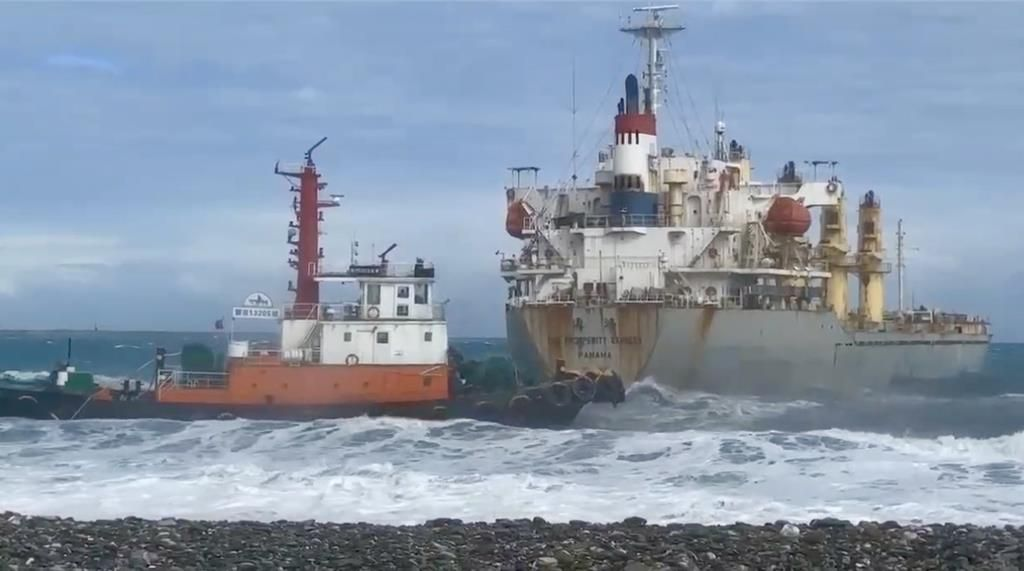
A New Year incident off Hualien, Taiwan, involving the Panama-flagged bulk carrier CSE PROSPERITY EXPRESS and a harbour tug is being cited as a sharp reminder of how a machinery breakdown in rough metocean conditions can quickly turn into multiple casualties.
On 1 January 2026, the bulk carrier reported a main engine failure while on pilot boarding standby for Hualien Port’s Berth 22. With propulsion lost, the ship was driven by strong northeast monsoon winds and heavy seas, drifting toward the coast and finally grounding on the northern side of the Hualien River mouth, near the Huaren seawall and the nearby beach area.
Harbour authorities deployed two port tugs to connect towing gear and support refloating efforts. During these manoeuvres, one tug experienced a serious problem when a tow line reportedly fouled its propulsion system. The tug then lost power and, in turn, ended up aground or stranded near the rocky and sandy shoreline.
Given the sea state and the tug’s position close to the surf zone, evacuation by boat was considered too risky. A Black Hawk helicopter was tasked with the winch operation, airlifting five crew members from the tug. One of them suffered a head wound and was taken ashore for medical treatment.
According to publicly available reports, seafarers on board the CSE PROSPERITY EXPRESS remained safe and were not in immediate danger. Authorities convened an emergency response meeting and arranged extra towage and salvage capacity. Further information on refloating efforts, the ship’s structural condition, and any pollution threat is expected to be released through official channels.
For ship operators and marine insurers, the sequence of events illustrates how a combination of technical failure and adverse metocean conditions can escalate. Losing power while a vessel is waiting for a pilot or anchorage in strong wind and swell can quickly result in uncontrolled drift and grounding. Towing operations under these conditions depend heavily on disciplined line handling, clear timing windows, and sufficient manoeuvring room; one entangled or parted line can convert a rescue platform into another casualty.
Early, conservative choices regarding weather limits, standby tug readiness, and the use of contingency anchors can significantly reduce the severity of such incidents. Confirmed findings on the cause of the engine breakdown, the extent of damage, and the progress of any refloating work are expected to be communicated through official updates and should be closely monitored by stakeholders.