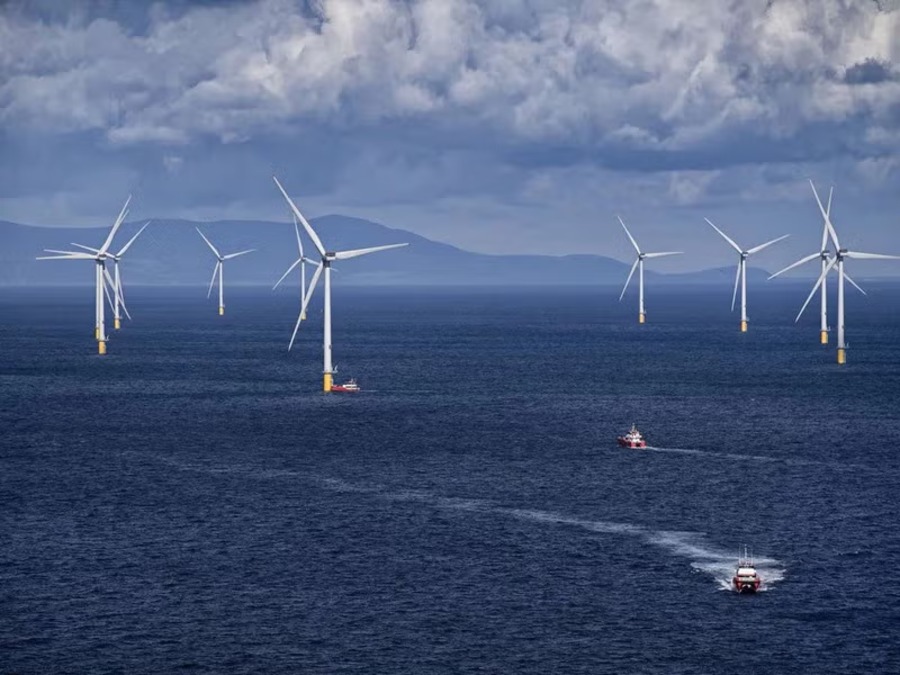
Classification society DNV has found that greater turbine standardisation and more predictable project pipelines, supported by longer production runs, could reduce the levelized cost of energy (LCoE) for North Sea offshore wind by as much as 28% by 2050 under a high-volume scenario.
DNV led a joint industry project involving EEW Special Pipe Constructions, Fred Olsen Windcarrier, Groningen Seaports, Iemants, Jan De Nul, Van Oord, Vattenfall Vindkraft and Vestas Wind Systems. The initiative was undertaken amid rising project costs, uneven auction results and stop-start development pipelines across the European offshore wind supply chain.
The study examines three North Sea scenarios between 2025 and 2050. Rather than considering turbine upscaling alone, the modelling also assesses whether keeping existing turbine platforms in production for longer periods could lower LCoE.
For the business-as-usual case, moderate market growth and a short production run for the current turbine platform result in an estimated LCoE decrease of about 5% by 2035.
When production runs are extended while market growth remains at the same level, the model shows a reduction of about 14% by 2035 and 25% by 2050. The highest-volume case produces the largest change, with sustained deployment resulting in reductions of about 19% by 2035 and 28% by 2050.
Turbines of around 15MW installed on monopile foundations serve as the reference platform for the modelling. The study does not define 15MW as the optimum turbine capacity and does not restrict further development of larger or different turbine platforms.
Ditlev Engel, CEO of energy systems at DNV, said Europe’s long-term offshore wind targets need to be accompanied by project pipelines that provide sufficient certainty for investment. He said steadier demand and extended production runs could improve the use of existing capacity and help identify where further investment is required.
Capital expenditure accounts for most of the cost reduction identified by the model. Turbine and project-development costs provide the largest contribution, with additional savings coming from installation and substructures. Maintaining stable turbine platforms could also support reliability and energy output, while shorter delivery schedules would allow generation to start earlier.
DNV’s modelling indicates that Europe has sufficient existing capacity for most near-term requirements involving turbines of around 15MW. Conditions change under the high-volume scenario, where port capacity becomes a constraint and installation capacity moves close to its limit. Expansion and selected upgrades would therefore be required in that scenario.
The study identifies actions for different parts of the offshore wind sector. Policymakers are called on to provide clearer visibility of future deployment through regular auction schedules and project pipelines. Developers and turbine manufacturers are encouraged to reach agreement earlier on design envelopes and interfaces, while suppliers are advised to direct investment towards identified constraints before pursuing wider capacity expansion.
Peter Constantin Brun, global segment leader for offshore wind at DNV, said the project had quantified the economic effect of industrialisation and standardisation in greater detail, identifying cost-reduction potential of up to 28% when deployment conditions support sustained volumes.
More stable designs and processes could also lower waste, rework, transport requirements and energy use. Earlier project completion could provide further environmental gains by allowing offshore wind generation to displace fossil-fuel generation sooner.
According to DNV, achieving the full savings identified by the modelling depends on greater long-term certainty across the supply chain. This includes regular auctions, clearer visibility of upcoming projects and regulatory conditions that allow industrialisation and standardisation to be applied more consistently.
The scenarios use DNV’s Energy Transition Outlook 2025 and North Sea Forecast, project pipeline data, and deployment ambitions contained in the Ostend and Hamburg declarations.