
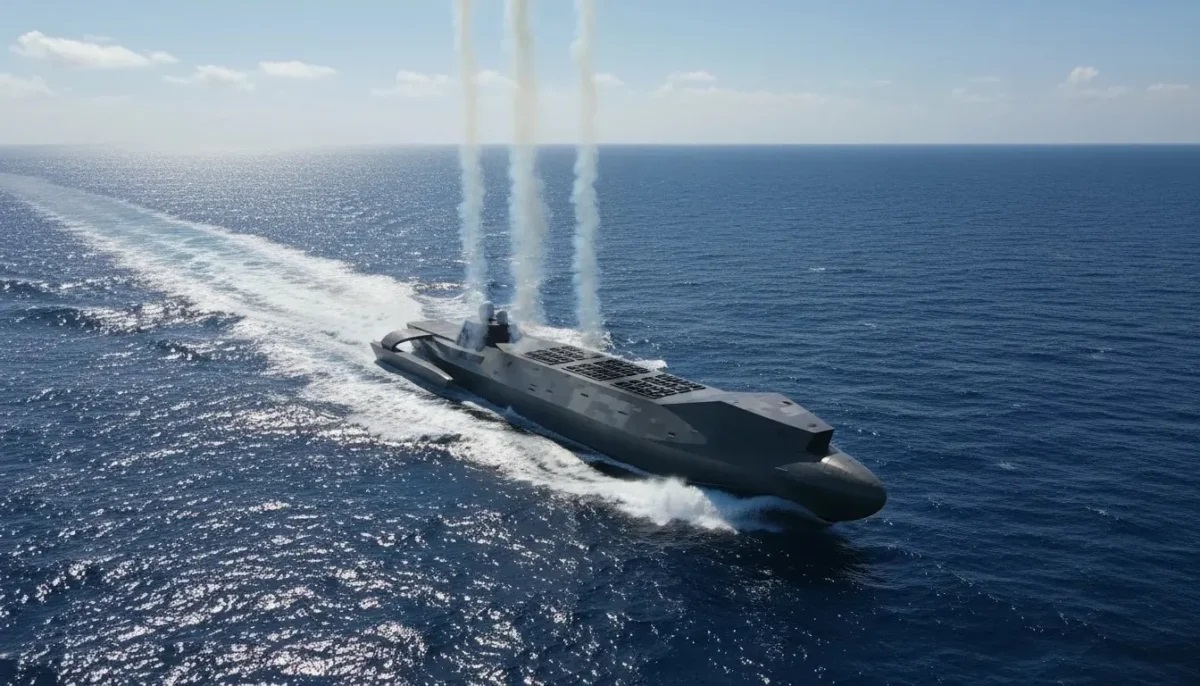
A clear view of an unusual Chinese semi-submersible trimaran has emerged from the People’s Liberation Army Navy’s Huangpu Shipyard in Guangzhou, showing a vessel that blends characteristics of both surface ships and submersibles.
The image, now widely shared online, seems to show the craft at the Huangpu facility, where satellite imagery has been tracking its presence for several months.
Based on visual estimates, the vessel is about 65 m long, roughly 210 feet. It uses a trimaran configuration, with a narrow central hull flanked by two side hulls, and carries a dark grey to almost black paint scheme more commonly seen on submarines than on surface warships.
The superstructure is very low, with only a slim, sail-like tower rising above the main deck. This structure appears to house a snorkel, an antenna mast, or both, leading analysts to suggest that the craft may be able to operate close to or below the surface for extended periods.
Naval specialist H. I. Sutton had earlier highlighted the vessel when it was visible under covers in satellite photos. Defence observers now note that its shape and hull markings resemble those of a submersible platform, including depth markings on the sail and along the hull sides.
At the stern, analysts have identified a shrouded propulsor that some interpret as a possible pump-jet installation. Pump-jet propulsion is understood to offer higher speeds with reduced cavitation, which can support quieter movement over long distances.
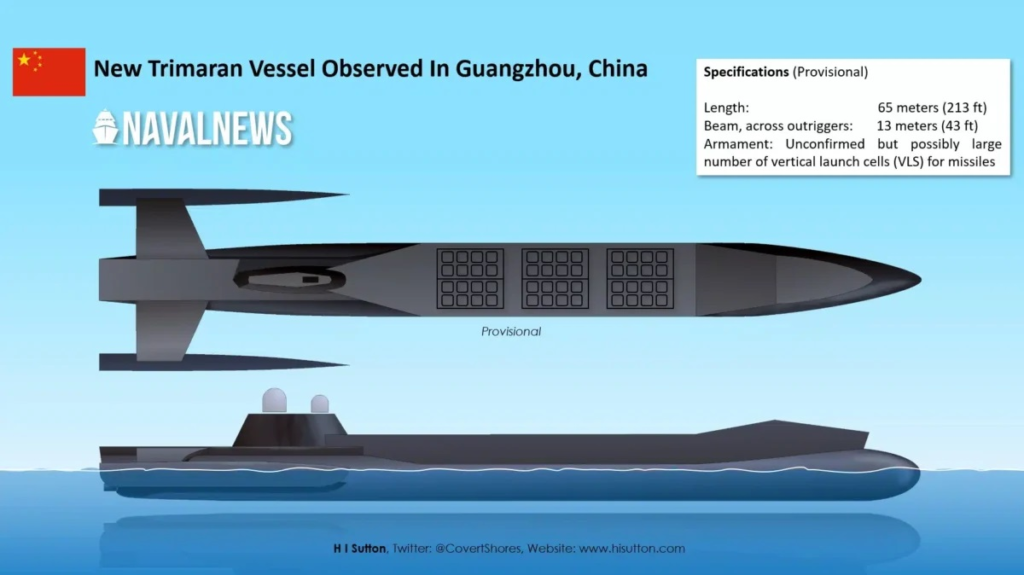
A key unknown is whether the platform is intended to be crewed. The absence of obvious accommodation spaces, missile cells or large sensor arrays has led several experts to argue that it could be uncrewed or only lightly manned. In that case, they suggest it might sit between typical uncrewed surface vessel (USV) designs and uncrewed underwater vehicle (UUV) concepts, effectively operating as a semi-submersible system.
Several potential roles have been discussed. One prominent theory is that the craft could act as a semi-submerged arsenal platform, able to carry and launch land-attack or anti-ship missiles before submerging. However, no vertical launch systems have yet been clearly identified on the deck. Analysts also recall that talk of such a vessel circulated in China as early as 2017, although much of the coverage at that time relied on unverified reports and speculative illustrations.
Another line of analysis is that the trimaran may be intended as a drone “mothership”, with space inside the hull for air or underwater unmanned systems. In that scenario, the vessel would not necessarily need a conventional flight deck if drones were launched by rail or catapult, similar to methods used for some long-range attack drones.
Some commentators have also proposed that the craft could be designed to support special operations forces. They note that Western militaries operate comparable low-profile, semi-submersible craft to move troops discreetly in coastal or island regions, raising the possibility that China is pursuing a similar capability.
A more cautious assessment is that the trimaran may simply serve as an experimental test platform. For now, its exact mission and final operational role remain unclear.
