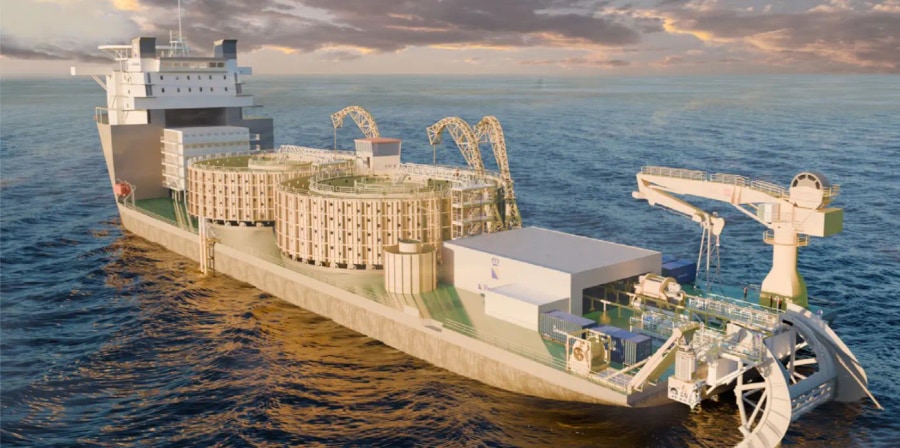
Royal Boskalis has announced plans to build a new high-capacity cable lay vessel to support growing demand for offshore power transmission linked to offshore wind and interconnector projects.
The new vessel will be equipped with two 12,000-tonne cable carousels, giving it a combined carrying capacity of 24,000 tonnes. One of the carousels will feature a concentric design intended to transport larger volumes of high-voltage direct current cable in continuous lengths.
According to Royal Boskalis, the design can help reduce the number of offshore cable joints, lowering installation risk and supporting long-term reliability for subsea power transmission systems.
The vessel is scheduled to enter service in 2029 and will target offshore wind developments and cross-border interconnector projects, where transmission distances are continuing to expand.
The investment comes as governments and energy developers move ahead with grid expansion programmes linked to decarbonisation and energy security objectives. Offshore wind farms are also being developed farther from shore, increasing demand for long-distance subsea transmission infrastructure.
Royal Boskalis said its offshore activities combine cable installation with seabed preparation, trenching, survey work and rock installation services.
The Dutch contractor has more than 15 years of subsea cable installation experience and has completed over 140 offshore cable-related projects. Its current fleet includes three cable lay vessels, a trenching support vessel and a range of specialised trenching equipment.